
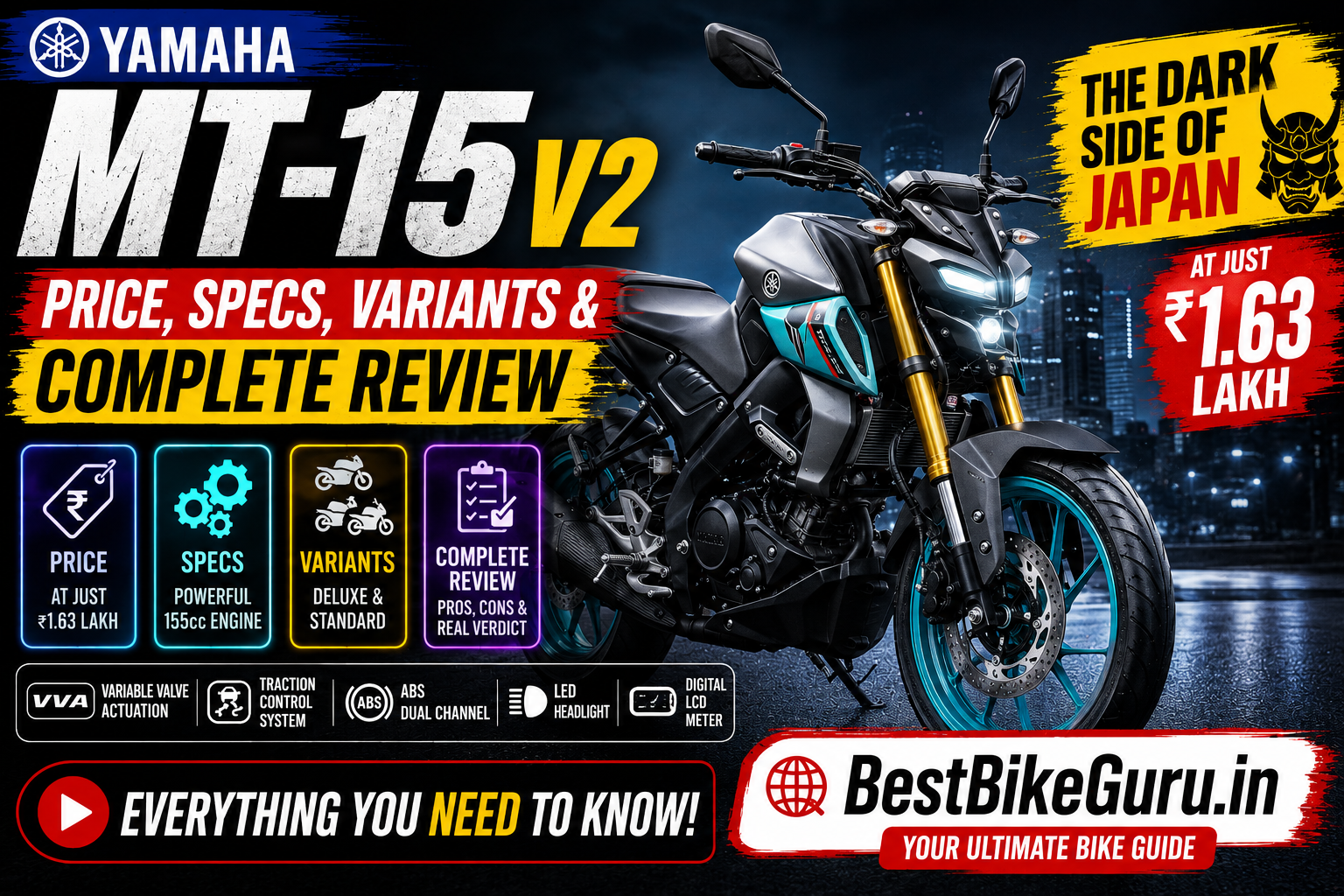
Yamaha MT-15 V2 2026 complete review price starting ₹1.63 lakh, 155cc VVA engine, 3 variants including TFT DLX, 47 kmpl mileage, USD forks, Y-Connect Bluetooth. Full specs, on-road price, comparison vs KTM 160 Duke, Bajaj NS200, Honda Hornet 2.0. Honest verdict inside.
There are motorcycles that move you from point A to point B. And then there are motorcycles that make you look forward to the journey, regardless of where you are going. The Yamaha MT-15 V2 firmly belongs to the second category and at a starting price of just ₹1.63 lakh (ex-showroom), it delivers an experience that has no business existing at this price point.
The MT-15 V2 is Yamaha’s entry-level naked streetfighter, positioned as a naked, stripped-down counterpart to the iconic R15 V4. Both share the same brilliant 155cc, liquid-cooled, VVA-equipped engine but where the R15 wraps that motor in a full fairing and race-crouch ergonomics, the MT-15 V2 removes all of it. No fairing, wide handlebars, upright stance, exposed mechanical details, and an aggressive insect-eyed headlamp design that Yamaha calls the “Dark Side of Japan” aesthetic.
The result is a motorcycle that looks like a miniature version of the larger MT-07 and MT-09 Yamaha’s global naked superbikes and rides with a lightness, agility, and mechanical precision that makes it genuinely addictive in city traffic and engaging on weekend spirited rides.
In 2026, the MT-15 V2 received a ₹3,800 price hike across all variants a modest increase attributed to rising input and logistics costs, but one that still keeps the bike firmly within the most competitive bracket of Indian premium streetfighters. With pricing now starting at ₹1,63,590 and going up to ₹1,72,830 for the full-featured DLX TFT variant, the MT-15 V2 continues to be one of the most compelling buys in the Indian 150cc premium segment.
In this complete 2026 review, we cover every angle the “Dark Side of Japan” design story, the VVA engine’s real character, all three variants and their features, real-world mileage data, and a comprehensive comparison against its key rivals.
Quick Snapshot: Yamaha MT-15 V2 (2026) at a Glance
| Feature | Details |
|---|---|
| Launch Year | 2022 (V2); Available & Updated for 2026 |
| Starting Price (Ex-Showroom) | ₹1,63,590 (Standard, Maharashtra) |
| Top Variant Price | ₹1,72,830 (DLX TFT, Maharashtra) |
| Delhi On-Road Price | ₹1,89,913 (All variants, approx.) |
| Engine | 155cc, Single-Cylinder, Liquid-Cooled, VVA |
| Max Power | 18.4 PS @ 10,000 rpm |
| Max Torque | 14.1 Nm @ 7,500 rpm |
| Transmission | 6-Speed Manual |
| Clutch | Slip & Assist (Slipper Clutch) |
| Frame | Deltabox Aluminium |
| Front Suspension | 37mm USD (Upside Down) Forks |
| Rear Suspension | Link-Type Monoshock |
| Front Wheel | 17-inch Alloy |
| Rear Wheel | 17-inch Alloy |
| Front Tyre | 100/80-17 |
| Rear Tyre | 140/70-17 |
| Front Brake | 282mm Disc |
| Rear Brake | 220mm Disc |
| ABS | Dual-Channel (DLX Variant) / Single-Channel (Standard) |
| Traction Control | Yes (TCS) |
| Fuel Tank | 10 Litres |
| Kerb Weight | 141 kg |
| Seat Height | 810 mm |
| Ground Clearance | 162 mm |
| Wheelbase | 1,325 mm |
| ARAI Mileage | 47 kmpl |
| Real-World Mileage | 45–52 kmpl |
| Top Speed | ~122–130 kmph |
| Colours | 8 colour schemes across 3 variants |
| Variants | 3 — Standard, Standard SPL, DLX TFT |
The “Dark Side of Japan” Philosophy: What It Really Means
Before diving into technical specifications, it is worth understanding the design language that defines the MT-15 V2 — because it is not just an aesthetic choice. It is a complete philosophy that shapes how this motorcycle looks, feels, and rides.
Yamaha’s global MT (Master of Torque) family which includes the MT-07, MT-09, and MT-10 — is built around the idea of “mechanical beauty.” These are motorcycles that celebrate their own engineering, with exposed frames, aggressive proportions, and a deliberate rawness that stands in contrast to the smooth, flowing lines of fully-faired sportbikes. Yamaha calls this aesthetic the “Dark Side of Japan” — a nod to the sinister, purposeful aggression of the design that references Japanese engineering precision through a dark, urban lens.
The MT-15 V2 is the entry point to this philosophy in India. And Yamaha has been remarkably faithful to it at a price point where most manufacturers would make significant compromises. The exposed Deltabox aluminium frame, the insect-eyed bi-functional LED headlamp, the compact muscular proportions all of these are present and executed with conviction, not cost-cutting.
For a young Indian rider who wants a motorcycle that stands out visually and carries a genuine design philosophy rather than just aggressive plastic panel graphics the MT-15 V2 is unique in the 155cc segment.
Design & Styling: Smallest Member of a Global Family
The Headlamp: The Signature Detail
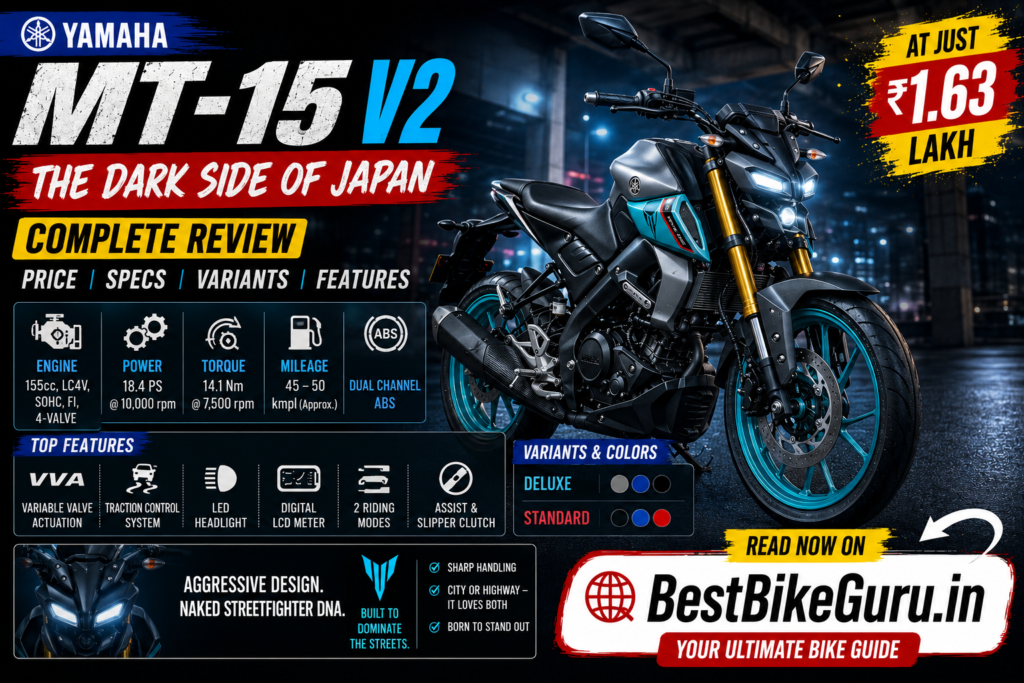
The most immediately recognizable element of the MT-15 V2 is its bi-functional LED projector headlamp — a stacked, multi-element unit that gives the bike its characteristic insect-eye appearance. This is not just a styling exercise; it is a deliberate design signature shared with the larger MT-07 and MT-09. The headlamp provides excellent illumination at night the projector beam is sharp and throws a strong, well-defined light pattern on the road ahead, significantly better than the reflector-type headlamps found on most 150cc competitors.
Flanking the headlamp are integrated DRL (Daytime Running Light) strips that give the front end a premium, always-on presence. The overall front face of the MT-15 V2 projects an intensity that makes riders of competing 150cc motorcycles look twice.
The Deltabox Frame: Structural Art
One of the most distinctive visual elements of the MT-15 V2 is its exposed aluminium Deltabox frame. Unlike most motorcycles at this price point where the frame is largely hidden under plastic bodywork, the MT-15 V2’s frame is deliberately visible a central design element rather than a structural component to be concealed. The silver-finished aluminium sections contrast with the bike’s body colour to create a layered, mechanical aesthetic that genuinely looks expensive.
The Deltabox frame is not merely decorative. It is Yamaha’s proprietary high-rigidity aluminium frame technology the same type used on the R15 V4 and the global MT series which provides superior rigidity-to-weight ratio compared to steel tubular frames. This directly translates to better handling precision and a more confidence-inspiring ride.
Fuel Tank and Body Proportions
The fuel tank is muscular with sharp extensions that flow into the side panels, giving the bike a compact but powerful visual presence. The overall proportions are compact the wheelbase of just 1,325mm makes the bike look tight and taut. Despite being a 155cc machine, the MT-15 V2 looks significantly larger and more substantial in person than its displacement might suggest.
The minimalist rear section with a compact tail lamp and split seat setup continues the streetfighter theme everything that isn’t necessary has been removed, leaving a lean, focused silhouette.
Colour Options: 8 Schemes Across Variants
The MT-15 V2’s colour range is one of its strong selling points. Eight distinct colour schemes across three variants ensure that riders can find a combination that matches their personality:
| Variant | Available Colours |
|---|---|
| Standard | Metallic Black, Dark Matte Blue |
| Standard SPL | Cyan Storm / Ice-Fluo Vermillion, Metallic Black Racing Blue |
| DLX TFT | Dark Matte Blue (DLX), Monster Energy Yamaha MotoGP Edition, Cyber Green |
The Monster Energy Yamaha MotoGP Edition with its signature blue-and-white Rossi-era inspired livery — is the most talked-about colour option and commands significant attention on the road. The Cyber Green (added in the latest update) is fresh and distinctive, giving younger buyers a colour option that stands apart from the black-and-blue palette that dominates the segment.
Engine & Performance: The VVA Advantage
The 155cc VVA Engine Shared with the R15 V4
The heart of the MT-15 V2 is the same 155cc, single-cylinder, liquid-cooled engine with Variable Valve Actuation (VVA) that powers the Yamaha R15 V4 one of India’s most celebrated performance motorcycles. This engine sharing is significant because it means the MT-15 V2 inherits the same precision engineering, build quality, and performance character as a motorcycle that enthusiasts have been praising for years.
Engine Specifications
| Specification | Detail |
|---|---|
| Displacement | 155cc |
| Configuration | Single-Cylinder, Liquid-Cooled, SOHC |
| VVA | Variable Valve Actuation |
| Max Power | 18.4 PS @ 10,000 rpm |
| Max Torque | 14.1 Nm @ 7,500 rpm |
| Bore x Stroke | 58mm x 58.7mm |
| Gearbox | 6-Speed |
| Clutch | Slip & Assist (Slipper) |
What is VVA and Why Does It Matter?
Variable Valve Actuation (VVA) is an engine technology that Yamaha has brought from its MotoGP racing programme to its production motorcycles. In simple terms, VVA allows the engine to switch between two different camshaft profiles depending on the engine speed a low-RPM cam profile for better low-end tractability and fuel efficiency, and a high-RPM cam profile for maximum top-end power.
The VVA kicks in at around 7,000 rpm, and the bike feels a bit held back up to 3,500–4,000 rpm, after which the MT-15 lets loose if you wring the throttle hard. This two-stage power delivery gives the MT-15 V2 a very distinctive ride character. Below 7,000 rpm, it is smooth and manageable perfect for city traffic. Above 7,000 rpm, as the VVA switches cam profiles, the engine pulls with noticeably more urgency and enthusiasm, propelling the bike towards its redline at 10,000 rpm with an energy that feels genuinely exciting.
This VVA-enabled two-character engine is what makes the MT-15 V2 special. It is a commuter below 7,000 rpm and a sportbike above it and the transition between the two personalities is what makes riders keep finding excuses to ride it.
Real-World Performance Numbers
| Metric | Figure |
|---|---|
| 0–60 kmph | ~5.2–5.6 seconds |
| 0–100 kmph | ~10–11 seconds |
| Top Speed | ~122–130 kmph |
| Comfortable Highway Cruise | 80–95 kmph |
The MT-15 V2 is not a motorcycle designed for maximum outright speed — and its numbers reflect that. Unlike the previous-gen MT-15’s top speed of 130 kmph, the V2 begins to feel strained at 122 kmph a conscious tuning choice by Yamaha to prioritise mid-range performance and fuel efficiency over top-end velocity. For city riding and weekend spirited runs on typical Indian roads, this is not a limitation that riders feel in practice.
Mileage: The Segment Leader
| Condition | Mileage |
|---|---|
| ARAI Claimed | 47 kmpl |
| City (Real-World) | 45–50 kmpl |
| Highway (Real-World) | 48–55 kmpl |
| Owner Average | 47 kmpl |
According to user-reported data, the Yamaha MT-15 V2 gives an average mileage of 47 kmpl. This is exceptional for a liquid-cooled, VVA-equipped performance engine. The MT-15 V2 is simultaneously the most refined engine in its segment and one of the most fuel-efficient. However, it must be noted that the 10-litre fuel tank is smaller than most rivals at 47 kmpl average, that gives approximately 470 km of range, which is adequate for city use but means you fill up more frequently on longer trips.
Variants & Pricing: Which One Makes Sense?
The Yamaha MT-15 V2 is available in 3 variants in 2026, each offering a progressively more feature-rich package:
Variant-Wise Price & Feature Comparison
| Feature | Standard | Standard SPL | DLX TFT |
|---|---|---|---|
| Ex-Showroom (Maharashtra) | ₹1,63,590 | ₹1,64,490 | ₹1,72,830 |
| Ex-Showroom (Delhi, Approx.) | ₹1,62,800 | ₹1,63,700 | ₹1,72,040 |
| On-Road (Delhi, Approx.) | ₹1,88,000 | ₹1,89,000 | ₹1,99,000 |
| Engine | 155cc VVA | 155cc VVA | 155cc VVA |
| ABS | Single-Channel | Single-Channel | Dual-Channel |
| TCS (Traction Control) | Yes | Yes | Yes |
| Display | Digital (Negative LCD) | Digital (Negative LCD) | TFT Colour |
| Y-Connect Bluetooth | No | No | Yes |
| Smartphone Connectivity | No | No | Yes |
| USD Front Forks | Yes | Yes | Yes |
| Slipper Clutch | Yes | Yes | Yes |
| LED Headlamp | Yes | Yes | Yes |
| Hazard Switch | No | No | Yes |
| Colour Options | 2 | 2 | 3–4 |
| Special Edition Colours | No | Yes (Cyan Storm etc.) | Yes (MotoGP Edition) |
Which Variant is Right for You?
Standard (₹1.63 lakh): The entry point. Gets the core MT-15 V2 experience VVA engine, USD forks, slipper clutch, traction control, full LED lighting, and the iconic design. The single-channel ABS is the only real limitation. For budget-conscious buyers who primarily ride in the city, this is an excellent choice.
Standard SPL (₹1.64 lakh): Just ₹900 more than Standard an almost negligible premium for exclusive special-edition colour options like Cyan Storm and Ice-Fluo Vermillion. If you want a more distinctive look without spending more, this is the smartest variant to choose. Mechanically identical to Standard.
DLX TFT (₹1.72 lakh): The complete package. The ₹9,240 premium over Standard brings three meaningful upgrades: dual-channel ABS (significantly better safety), a TFT colour display (more readable, more information), and Y-Connect Bluetooth (smartphone connectivity for call alerts, navigation, and bike health monitoring). For any rider who values safety and modern connectivity and most should the DLX TFT is the variant to choose. The dual-channel ABS alone justifies the upgrade.
Also Read : TVS Jupiter 125 Complete Review 2026 | Price, Mileage, Features & Specs
Features & Technology: Premium Where It Counts
Standard Features Across All Variants
| Feature | Status |
|---|---|
| 155cc VVA Engine | Standard |
| 37mm USD Front Forks | Standard |
| Link-Type Rear Monoshock | Standard |
| Slip & Assist Slipper Clutch | Standard |
| Traction Control System (TCS) | Standard |
| Bi-Functional LED Headlamp | Standard |
| Full LED Lighting | Standard |
| Digital Instrument Console | Standard |
| Gear Position Indicator | Standard |
| Side-Stand Engine Cut-Off | Standard |
| 6-Speed Gearbox | Standard |
| Disc Brakes (Front & Rear) | Standard |
DLX TFT Exclusive Features
| Feature | Details |
|---|---|
| TFT Colour Display | Full colour, more readable display with richer information layout |
| Y-Connect Bluetooth | Yamaha’s proprietary smartphone connectivity app |
| Call & SMS Alerts | Phone notifications on the display while riding |
| Last Parked Location | GPS tracking of where you parked |
| Malfunction Notification | Real-time engine warning alerts |
| Fuel Consumption Tracking | Live fuel efficiency monitoring |
| Average Speed Display | Trip computer data |
| Battery Voltage Monitoring | Real-time battery health |
| Dual-Channel ABS | Both wheels protected — safer in emergency braking |
| Hazard Warning Switch | Essential safety feature for highway emergencies |
The Y-Connect App: Yamaha’s Connected Ecosystem
The Y-Connect Bluetooth system on the DLX TFT variant pairs with Yamaha’s dedicated smartphone app to deliver a range of connected features that go beyond what most riders expect from a 155cc motorcycle. The app allows riders to track their last parked location genuinely useful if you park in a crowded market or unfamiliar area monitor fuel consumption patterns over time, receive real-time malfunction alerts, and review maintenance reminders. It is a practical, well-implemented connected system that adds genuine daily value rather than being a gimmick.
The USD Forks: A Key Hardware Advantage
The 37mm USD (Upside Down) front forks are standard across all MT-15 V2 variants and they are a significant reason for the bike’s exceptional handling character. USD forks provide better rigidity under braking and cornering inputs, reduced unsprung weight, and improved front-end feedback compared to conventional telescopic forks. Most competing motorcycles at this price point use conventional forks. The MT-15 V2’s USD hardware gives it a handling precision advantage that riders notice immediately during any directional change.
Handling & Ride Quality: Where the MT-15 V2 Shines Brightest
If there is one area where the MT-15 V2 is genuinely exceptional one area that consistently gets called out in owner reviews and first-ride impressions it is the handling.
The combination of the Deltabox aluminium frame, 37mm USD forks, 141 kg kerb weight (the lightest in its segment), and a tight 1,325mm wheelbase creates a handling package that is genuinely impressive. The bike changes direction with a sharpness and immediacy that feels almost telepathic at times.
The lightweight chassis and Deltabox frame provide excellent handling stability. At speeds of 60–80 km/h, the bike remains planted and responsive. Cornering confidence is one of its strongest attributes in this segment.
In city traffic, the 141 kg kerb weight and compact dimensions make it one of the easiest motorcycles to thread through gaps, execute U-turns, and manoeuvre in parking situations. Riders upgrading from heavier 200cc or 250cc bikes consistently report being surprised by how much more nimble the MT-15 V2 feels despite its smaller displacement.
On weekend spirited runs on winding roads, the USD forks and Deltabox frame give the front end strong feedback and cornering confidence — you can feel exactly what the front tyre is doing, which encourages more confident cornering. This level of chassis communication is rare at this price point.
The One Honest Caveat: Ride Comfort
The MT-15 V2’s firm suspension setup tuned for handling precision rather than comfort means that on very rough Indian roads, broken tarmac, and deep potholes, the ride can feel stiff and transmits more impacts to the rider than softer-sprung commuters. Multiple owner reviews note the firm seat as a minor discomfort on very long rides. For city commuting and weekend rides of up to 150–200 km, this is perfectly manageable. For multi-day, 400+ km touring, the firm setup will become noticeable.
On-Road Price: City-Wise Breakdown
| City | Standard | Standard SPL | DLX TFT |
|---|---|---|---|
| Delhi | ₹1,88,000 | ₹1,89,000 | ₹1,99,000 |
| Mumbai | ₹1,91,000 | ₹1,92,000 | ₹2,02,000 |
| Bangalore | ₹1,86,000 | ₹1,87,000 | ₹1,97,000 |
| Chennai | ₹1,84,000 | ₹1,85,000 | ₹1,95,000 |
| Hyderabad | ₹1,87,000 | ₹1,88,000 | ₹1,98,000 |
| Pune | ₹1,89,000 | ₹1,90,000 | ₹2,00,000 |
On-road prices are estimates including RTO, insurance, and handling charges. Confirm exact figures at your nearest Yamaha dealership.
Also Read : Yamaha RX100 2026 India – Real Launch or Just Clickbait? The Complete Truth
EMI Estimates (Indicative)
| Variant | Down Payment (10%) | Monthly EMI (~8.5%, 36 Months) |
|---|---|---|
| Standard | ₹16,359 | ₹4,250 |
| Standard SPL | ₹16,449 | ₹4,270 |
| DLX TFT | ₹17,283 | ₹4,490 |
At ₹4,250 per month for the Standard variant, the MT-15 V2 is one of the most affordable paths to a genuinely premium motorcycle experience in India. The DLX TFT’s EMI at ₹4,490 a difference of just ₹240 per month over Standard makes the upgrade to dual-channel ABS and TFT display a financially easy decision.
Competitor Comparison: How the MT-15 V2 Stacks Up
| Feature | Yamaha MT-15 V2 | KTM 160 Duke | Honda Hornet 2.0 | Bajaj Pulsar NS200 |
|---|---|---|---|---|
| Price (Base, Ex-Show.) | ₹1.63 L | ₹1.74 L | ₹1.45 L | ₹1.35 L |
| Engine | 155cc, Liquid-Cooled, VVA | 164cc, Liquid-Cooled | 184cc, Liquid-Cooled | 199cc, Liquid-Cooled |
| Max Power | 18.4 PS | 19.4 PS | 17.26 PS | 24.5 PS |
| Max Torque | 14.1 Nm | 14.9 Nm | 16.1 Nm | 18.74 Nm |
| Frame | Deltabox Aluminium | Steel Trellis | Diamond Steel | Perimeter Steel |
| Front Suspension | 37mm USD | 43mm USD | Telescopic | Telescopic |
| Kerb Weight | 141 kg | 147 kg | 142 kg | 158 kg |
| Fuel Tank | 10 Litres | 10.2 Litres | 12 Litres | 12 Litres |
| ABS | Dual-Ch (DLX only) | Dual-Channel | Dual-Channel | Dual-Channel |
| Traction Control | Yes | No | No | No |
| Bluetooth | Yes (DLX only) | No | No | No |
| TFT Display | Yes (DLX only) | No | No | No |
| Slipper Clutch | Yes | Yes | No | No |
| ARAI Mileage | 47 kmpl | 36 kmpl | 40 kmpl | 36 kmpl |
| Top Speed | ~122–130 kmph | ~130 kmph | ~128 kmph | ~135 kmph |
| User Rating | 4.7/5 | 4.7/5 | 4.3/5 | 4.7/5 |
MT-15 V2 vs KTM 160 Duke
The KTM 160 Duke at ₹1.74 lakh ₹11,000 more than the MT-15 V2 Standard — is the most direct performance rival. The KTM has a slightly larger 164cc engine producing marginally more power (19.4 PS vs 18.4 PS), 43mm USD forks (larger diameter than the MT-15’s 37mm), and KTM’s signature razor-sharp performance character. However, the MT-15 V2 beats the KTM on mileage (47 kmpl vs 36 kmpl), offers traction control (KTM doesn’t), has a TFT display option (KTM doesn’t), and is significantly cheaper. The MT-15 V2 is priced at ₹1,63,798 with a 155cc engine giving 47 kmpl and weighing 141 kg, whereas the KTM 160 Duke is ₹1,74,303 with a 164cc engine giving 36 kmpl and weighing 147 kg. For outright performance and riding excitement, the KTM wins. For value, daily usability, and technology, the MT-15 V2 has the edge.
MT-15 V2 vs Honda Hornet 2.0
The Honda Hornet 2.0 at ₹1.45 lakh is cheaper and offers a larger 184cc engine with more torque. It is a solid, reliable choice with Honda’s trusted after-sales support. However, it lacks the Deltabox frame, USD forks, slipper clutch, traction control, Bluetooth connectivity, and TFT display that the MT-15 V2 offers. The Hornet 2.0 is a simpler motorcycle; the MT-15 V2 is a more sophisticated one. The ₹18,000 price difference between the two is justified by the MT-15 V2’s significantly superior hardware and technology package.
MT-15 V2 vs Bajaj Pulsar NS200
The Bajaj Pulsar NS200 at ₹1.35 lakh is the most affordable option in this comparison and offers the most displacement at 199cc with 24.5 PS — significantly more power on paper. However, it uses a steel perimeter frame, conventional telescopic front forks, no slipper clutch, and no traction control. The MT-15 V2 gives up power but gains handling sophistication, a premium frame, USD forks, and a far better technology package. The Pulsar NS200 is the power-first choice; the MT-15 V2 is the precision-first choice.
The MT-15 V2’s Secret Weapon: Weight
At 141 kg kerb weight, the MT-15 V2 is the lightest motorcycle in its comparison segment. This seemingly simple specification has an outsized real-world impact. A lighter motorcycle is easier to manage in city traffic, more agile in direction changes, easier to balance at low speeds, and more confidence-inspiring for newer riders. The MT-15 V2’s 141 kg means it genuinely feels like an extension of the rider’s body inputs translate immediately and precisely to the motorcycle’s response.
Compare this to the Bajaj Pulsar NS200’s 158 kg, the KTM 160 Duke’s 147 kg, or the Honda Hornet’s 142 kg and the MT-15 V2’s weight advantage becomes a meaningful daily-use differentiator.
Who Should Buy the Yamaha MT-15 V2?
This Bike Is Perfect For You If:
- You want the most sophisticated chassis and handling in the 150–160cc segment Deltabox frame and USD forks at this price are unmatched
- Daily city commuting with weekend spirited riding is your primary use case the VVA engine’s two-character personality suits this perfectly
- Fuel efficiency matters the 47 kmpl average is the best in the premium 150cc segment
- You want a motorcycle with a genuine design philosophy the “Dark Side of Japan” aesthetic is distinctive and internationally inspired
- You are a newer rider who wants a lightweight, manageable, but genuinely premium motorcycle to grow with
- Yamaha brand reliability and service network are important considerations Yamaha’s pan-India service infrastructure is well-established
- You want modern connectivity Y-Connect Bluetooth, TFT display, and traction control on a 155cc bike is genuinely remarkable
This Bike May Not Be Right If:
- Maximum outright power is your priority the 18.4 PS figure is modest vs 200cc+ rivals
- You do frequent long-distance touring the 10-litre tank and firm suspension make 300+ km days harder than on more touring-oriented bikes
- Pillion comfort is important the split seat is compact and the rear suspension transmits road feedback to pillion passengers noticeably
- You want dual-channel ABS on a budget the Standard and Standard SPL variants have single-channel ABS only; dual-channel requires the DLX TFT upgrade
- Top speed matters to you the MT-15 V2 begins to feel strained at 122 kmph, which is lower than some 200cc rivals
Yamaha MT-15 V2 Pros
- Deltabox aluminium frame — premium chassis technology shared with R15 V4, unique in 155cc segment
- 37mm USD front forks standard across all variants — handling precision advantage over conventional fork rivals
- Lightest motorcycle in segment at 141 kg — nimble, easy to manage, confidence-inspiring
- VVA engine character — relaxed below 7,000 rpm, genuinely exciting above it; dual-personality engine
- Best ARAI mileage in segment at 47 kmpl — exceptional efficiency for a liquid-cooled performance engine
- Traction Control System (TCS) standard — safety tech rarely seen at this price
- Y-Connect Bluetooth + TFT display on DLX — class-leading connectivity at ₹1.72 lakh
- 8 colour schemes including MotoGP Monster Energy Edition — widest colour palette in class
- Slipper clutch standard — smooth downshifts, lighter lever pull in traffic
- Yamaha reliability and R15 V4 engine proven track record
- Bi-functional LED headlamp — excellent night visibility and distinctive look
- 2026 price hike only ₹3,800 — still outstanding value
Yamaha MT-15 V2 Cons
- Dual-channel ABS only on DLX TFT — Standard and Standard SPL get single-channel only
- 10-litre fuel tank — smaller than most rivals; frequent fills on long rides
- Firm suspension — stiff on very rough Indian roads; not ideal for long touring
- Top speed limited at ~122 kmph in real-world conditions
- Small pillion accommodation — compact seat is solo-rider optimised
- No quickshifter — rivals like the Bajaj NS400Z offer bidirectional quickshifter at higher price points
- 162mm ground clearance — among the lower figures in segment; careful on rough roads
- Bluetooth only on DLX — Standard buyers miss out on Y-Connect connectivity
- Wind buffeting at sustained highway speeds — the naked design means no fairing wind protection
Final Rating
| Category | Score |
|---|---|
| Design & Styling | 9.5 / 10 |
| Engine & Performance | 8.0 / 10 |
| Features & Technology | 8.5 / 10 |
| Handling & Chassis | 9.5 / 10 |
| Comfort & Ergonomics | 7.5 / 10 |
| Mileage & Efficiency | 9.5 / 10 |
| Value for Money | 9.0 / 10 |
| Overall | 8.8 / 10 |
Is the Yamaha MT-15 V2 Worth Buying in 2026?
The Yamaha MT-15 V2 is one of those motorcycles that is genuinely difficult to fault when evaluated against its price. At ₹1.63 lakh for the Standard variant and ₹1.72 lakh for the fully-loaded DLX TFT which brings dual-channel ABS, TFT display, and Bluetooth connectivity the MT-15 V2 delivers a combination of design quality, chassis sophistication, engine refinement, and technology that its competitors simply cannot match.
The VVA engine is unique in the segment its two-character personality makes every ride interesting, and its 47 kmpl mileage is a daily commuter’s dream. The Deltabox frame and USD forks give it handling that embarrasses more expensive motorcycles. The “Dark Side of Japan” design is distinctive, internationally inspired, and genuinely turns heads.
The honest limitations are real the 10-litre tank, firm suspension, modest top speed, and compact pillion setup mean the MT-15 V2 is not the right motorcycle for every use case. Long-distance tourers, power-obsessed riders, and regular two-up riders will find better options in the market.
But for the urban commuter who wants weekend excitement, the college rider who wants a motorcycle that looks like a global superbike DNA carrier, the new rider who wants premium handling on a tight budget, and anyone who values Yamaha’s world-class engineering philosophy at an accessible price — the MT-15 V2 in 2026 remains one of India’s finest two-wheeled value propositions.
It is not the most powerful. It is not the fastest. But it is, arguably, the most complete motorcycle you can buy in India under ₹2 lakh.
Yamaha MT-15 V2 FAQ
What is the price of the Yamaha MT-15 V2 in 2026?
After the 2026 price hike of ₹3,800, the MT-15 V2 is priced at ₹1,63,590 (Standard), ₹1,64,490 (Standard SPL), and ₹1,72,830 (DLX TFT) all ex-showroom Maharashtra. Delhi on-road prices start at approximately ₹1,89,913.
How many variants does the Yamaha MT-15 V2 come in?
Three variants: Standard, Standard SPL, and DLX TFT. The DLX TFT is the top variant with dual-channel ABS, TFT display, and Y-Connect Bluetooth.
What is the real-world mileage of the Yamaha MT-15 V2?
Owner-reported average mileage is approximately 47 kmpl. City riding returns around 45–50 kmpl, while highway riding can achieve 48–55 kmpl with a relaxed throttle. ARAI-claimed mileage is 47 kmpl.
What is VVA and how does it affect the MT-15 V2’s performance?
VVA (Variable Valve Actuation) is Yamaha’s technology that switches between two camshaft profiles at around 7,000 rpm. Below 7,000 rpm, the engine is smooth and fuel-efficient. Above 7,000 rpm, the cam switches to a high-performance profile, dramatically increasing the engine’s urgency and excitement. This gives the MT-15 V2 a uniquely dual-character engine personality.
Does the Yamaha MT-15 V2 have dual-channel ABS?
Dual-channel ABS is available only on the DLX TFT variant (₹1.72 lakh). The Standard and Standard SPL variants come with single-channel ABS. The DLX TFT is strongly recommended for maximum safety.
What is the seat height of the Yamaha MT-15 V2?
810mm on the taller side for Indian riders. Shorter riders (below 5’4″) may find it slightly challenging to get both feet flat on the ground. The lightweight 141 kg kerb weight helps compensate by making the bike easier to balance.
Does the MT-15 V2 have Bluetooth connectivity?
Yes, but only on the DLX TFT variant through Yamaha’s Y-Connect app. Standard and Standard SPL variants do not have Bluetooth. Y-Connect provides call alerts, parking location tracking, fuel consumption monitoring, and malfunction notifications.
How does the MT-15 V2 compare to the KTM 160 Duke?
The KTM 160 Duke has slightly more power (19.4 PS vs 18.4 PS), larger 43mm USD forks, and a sharper, more aggressive character. The MT-15 V2 is ₹11,000 cheaper, offers significantly better mileage (47 kmpl vs 36 kmpl), has traction control, and offers TFT display and Bluetooth options. The KTM wins on pure performance; the MT-15 V2 wins on value and technology.