
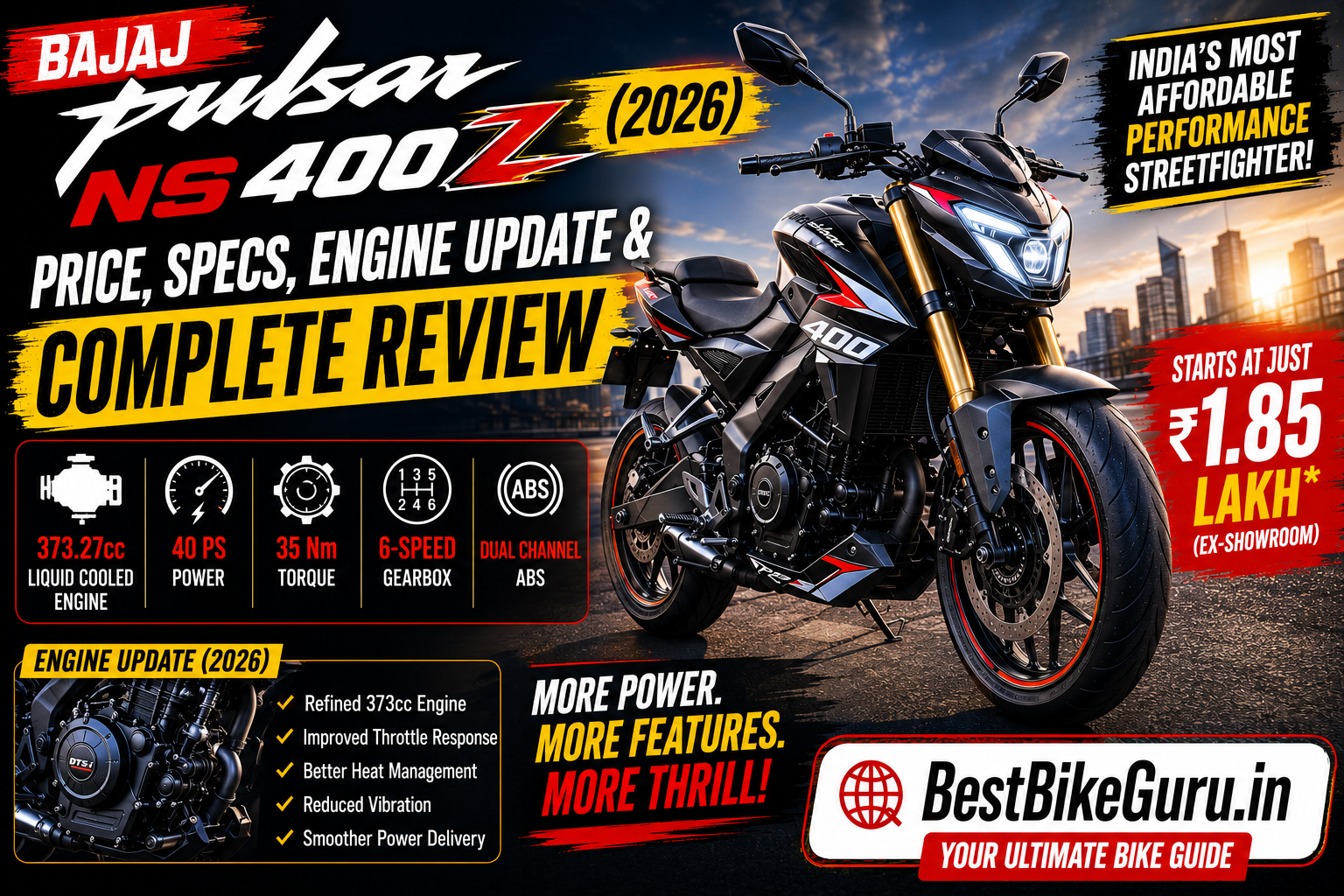
Bajaj Pulsar NS 400Z 2026 complete review now at ₹1.80 lakh with updated 349cc engine, 40.6 PS power, bidirectional quickshifter, 4 ride modes, USD forks. Full specs, on-road price, real-world mileage, comparison vs KTM 390 Duke, TVS Apache RTR 310. Honest verdict inside.
Ask any Indian motorcycle enthusiast to name the best value-for-money performance bike in India, and the name that comes up most consistently is the Bajaj Pulsar NS400Z. And in 2026, Bajaj just made that case even stronger.
Launched originally in 2024 as the biggest, most powerful Pulsar ever built, the NS400Z redefined what Indian riders could expect from a sub-₹2 lakh motorcycle. Full LED lighting, USD forks, a liquid-cooled DOHC engine, 4 ride modes, traction control, dual-channel ABS with ABS modes, Bluetooth connectivity, and turn-by-turn navigation at a price that was genuinely shocking even by Indian standards.
Then came 2026, and a major update that no one saw coming: Bajaj switched the NS400Z from its 373cc engine to a 349cc unit and in doing so, pushed the bike into India’s sub-350cc GST tax bracket, triggering a price cut of ₹14,000, bringing the ex-showroom price down to ₹1.80 lakh. At the same time, the complete 2025 mechanical update which included a bidirectional quickshifter, radial tyres, sintered brake pads, and a revised engine that pushed peak power to 40.6 PS remained fully intact.
The result is the most feature-complete, performance-packed motorcycle under ₹2 lakh in India. In this complete 2026 review, we cover everything: the GST update story, engine character, performance numbers, features, real-world mileage, and the honest truth about whether the NS400Z lives up to its extraordinary reputation.
Quick Snapshot: Bajaj Pulsar NS400Z (2026) at a Glance
| Feature | Details |
|---|---|
| Launch Year | 2024 (2026 Update: 349cc Engine + Price Cut) |
| Ex-Showroom Price (2026) | ₹1,80,092 |
| On-Road Price (Delhi, Est.) | ₹2,05,000–₹2,15,000 |
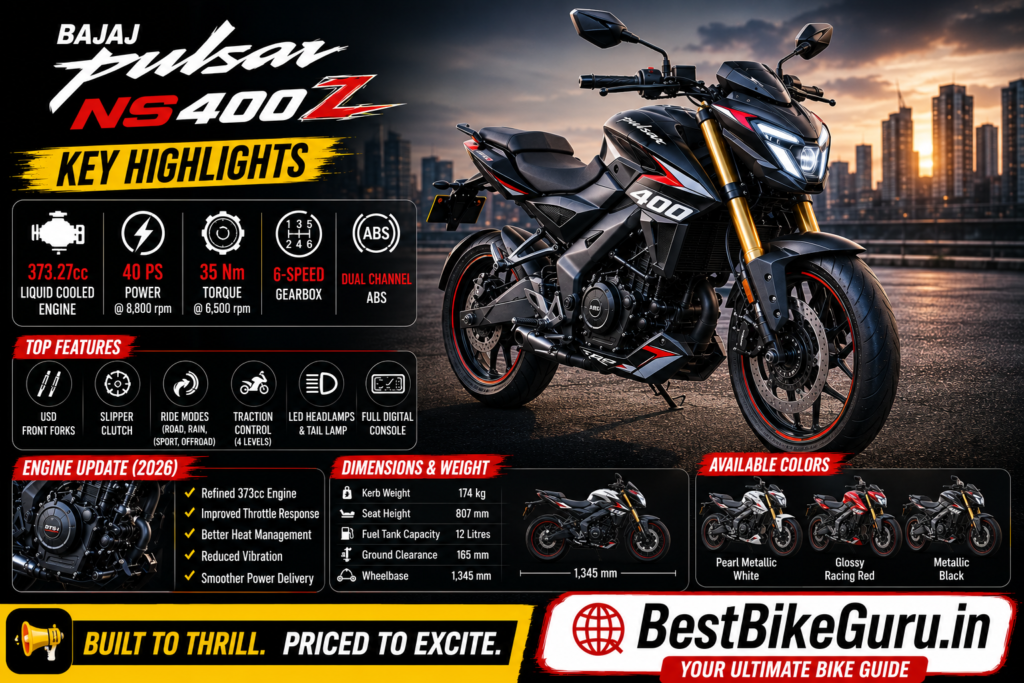
| Engine | 349.13cc, Single-Cylinder, Liquid-Cooled, DOHC, 4-Valve |
| Max Power | 40.6 PS @ 9,000 rpm |
| Max Torque | 33.2 Nm @ 7,500 rpm |
| Transmission | 6-Speed Manual |
| Quickshifter | Yes Bidirectional (Sport-Shift) |
| Clutch | Slip & Assist |
| Throttle | Ride-by-Wire (Electronic Throttle Control) |
| Riding Modes | 4 Road, Rain, Sport, Offroad |
| Frame | Perimeter Frame |
| Front Suspension | 43mm USD (Upside Down) Forks |
| Rear Suspension | Monoshock, Preload Adjustable |
| Tyres | Radial Tubeless (Front & Rear) |
| Front Brake | 320mm Disc, Sintered Brake Pads |
| Rear Brake | 230mm Disc |
| ABS | Dual-Channel with ABS Modes |
| Traction Control | Yes, Switchable |
| Fuel Tank | 12 Litres |
| Kerb Weight | 174–176 kg |
| Seat Height | 807 mm |
| Ground Clearance | 168 mm |
| ARAI Mileage | 28 kmpl |
| Real-World Mileage | 27–32 kmpl |
| Top Speed | ~157 kmph (Sport Mode) |
| 0–100 kmph | ~6.4 seconds |
| Colours | 4 Brooklyn Black, Pearl Metallic White, Glossy Racing Red, Pewter Grey |
| Variants | 1 (Standard) |
The 2026 Update: The GST Story You Need to Understand
The biggest news surrounding the Bajaj Pulsar NS400Z in 2026 isn’t a design change or a new feature it’s an engine displacement revision driven entirely by India’s GST taxation structure. And understanding it properly matters, because it directly affects how much you pay and what you get.
What Changed and Why
India’s GST framework places a significantly different tax burden on motorcycles above and below 350cc. Motorcycles with engine displacement of 350cc and below attract 18% GST, while those above 350cc fall into the 28% GST bracket. This is a substantial difference one that directly affects the ex-showroom price, insurance premiums, and registration costs.
Bajaj Auto has systematically worked through its 400cc portfolio to comply with India’s new GST 2.0 regulations, with the Pulsar NS400Z being the final piece of that puzzle. The KTM 390 Duke, 390 Adventure, and Dominar 400 had already undergone the same transition earlier.
The engineering solution was precise: the reduction in displacement was achieved by shortening the engine’s stroke while retaining the same bore dimension. This is not a crude downsizing it is a calculated engineering adjustment that keeps the engine’s fundamental architecture and hardware essentially identical.
What You Lose (And It’s Very Little)
The outgoing 373cc version made 43 PS in its top Sport riding mode and 35 Nm of torque. The new 349cc engine produces 40.6 PS and 33.2 Nm down by 2.4 PS and 1.8 Nm compared to its predecessor.
In real-world riding, this difference is essentially imperceptible. The power delivery character, the engine’s rev range, and the riding experience remain identical. What you gain is far more significant: a ₹14,000 price reduction at the showroom, lower insurance premiums, and reduced registration costs with Bajaj claiming total savings of up to ₹24,500 compared to the pre-GST 2.0 model.
What Stays the Same Everything Else
The bodywork, instrument cluster, riding modes, hardware, and feature set all carry over unchanged.The bidirectional quickshifter, radial tyres, sintered brake pads, 4 ride modes, USD forks every feature that made the NS400Z exceptional remains fully intact. This is the same motorcycle at a lower price. The value proposition, already extraordinary, has become even stronger.
Design & Styling: Streetfighter Aggression at Its Finest
The Bajaj Pulsar NS400Z’s design is built around a single philosophy: maximum aggression within a compact, stripped-down streetfighter silhouette. And it executes this philosophy with conviction.
Fighter Jet Inspiration
Bajaj’s design team has described the NS400Z as drawing inspiration from fighter jet aerodynamics and you can see it. The sharp, angular fuel tank shrouds, the aggressive floating body panels, and the compact, muscular proportions all project the same purposeful intensity you’d associate with a performance aircraft. The bike looks fast standing still.
The Signature Lightning Bolt DRL
The front end is defined by the Lightning Bolt DRL a distinctive daytime running light signature that wraps across the front face in a sharp, angular pattern. This is immediately recognizable and gives the NS400Z a modern, premium visual identity that punches well above its price bracket. The LED headlamp unit itself is sharp and provides excellent nighttime illumination.
Champagne Gold USD Forks
One of the most striking visual details of the NS400Z is its champagne gold-coloured USD forks. In a segment where most bikes get black or silver front forks, the gold finish immediately signals performance intent and gives the bike a premium, almost superbike-inspired look. Combine this with the carbon fibre accents on the body panels and the bold NS400Z callouts, and you have a motorcycle that looks significantly more expensive than it actually is.
Four Colour Options
| Colour | Character |
|---|---|
| Brooklyn Black | Dark, aggressive, most popular choice |
| Pearl Metallic White | Clean, premium, race-inspired |
| Glossy Racing Red | Bold, classic performance colour |
| Pewter Grey | Subtle, mature, understated |
All four colours are executed with quality paint finish and complementary decals. The Brooklyn Black, with gold fork accents, is arguably the most visually cohesive combination.
Ergonomics: Forward-Biased but Liveable
The NS400Z’s riding stance is described by Bajaj as forward-biased the rider leans slightly towards the handlebars rather than sitting fully upright. This creates a more engaged, sporty feel on the road while remaining comfortable enough for daily use. The 807mm seat height is accessible for most Indian riders, and the mid-set footpegs keep the riding triangle balanced not so aggressive that long rides become painful, not so relaxed that the bike loses its performance character.
Multiple owner reviews confirm that the NS400Z is comfortable for city commuting and weekend highway rides, though very long touring days (300+ km) will feel the forward bias eventually. This is a performance streetfighter first and a tourer second and the ergonomics honestly reflect that.
Engine & Performance: 40.6 PS for Under ₹2 Lakh
This is the section that makes every performance motorcycle enthusiast’s eyes widen. Because what the Bajaj Pulsar NS400Z delivers in terms of performance per rupee has no parallel in the Indian market.
Engine Specifications
| Specification | Detail |
|---|---|
| Displacement | 349.13cc |
| Configuration | Single-Cylinder, Liquid-Cooled, DOHC, 4-Valve |
| Max Power | 40.6 PS @ 9,000 rpm |
| Max Torque | 33.2 Nm @ 7,500 rpm |
| Bore x Stroke | Same bore, shortened stroke vs 373cc |
| Fuel System | Ride-by-Wire Electronic Fuel Injection |
| Gearbox | 6-Speed with Slip & Assist Clutch |
| Quickshifter | Bidirectional Sport-Shift (Clutchless Up & Down) |
| DLC Coating | Yes Diamond-Like Carbon coating on engine internals |
The engine specifications above represent an extraordinary performance-per-rupee achievement. 40.6 PS from a sub-₹2 lakh motorcycle is genuinely remarkable for context, the KTM 390 Duke produces 45.3 PS but costs ₹3 lakh, the TVS Apache RTR 310 produces around 35 PS and costs ₹2.21 lakh. The NS400Z sits closer to the KTM on power while undercutting it by over ₹1 lakh.
Platform Heritage: The KTM Connection
The NS400Z’s strong performance figures are not accidental they are the direct result of platform engineering that has deep KTM roots. The Pulsar NS400Z is based on the Dominar 400 platform, which is itself based on the KTM 390 Duke platform. This means the NS400Z’s fundamental architecture the engine design philosophy, the chassis geometry principles traces its lineage to one of the most celebrated performance motorcycles in India. Bajaj has localised, refined, and re-engineered this platform to deliver Indian-market value, but the performance DNA is unmistakably KTM-inspired.
The DLC-Coated Engine
One specification that deserves special attention is the Diamond-Like Carbon (DLC) coating on the NS400Z’s engine internals. DLC coating is an advanced surface treatment that reduces friction between moving engine parts the result is better engine efficiency, improved longevity, and lower heat generation under sustained high-rpm use. DLC coating is typically found on premium, high-performance engines. Finding it on a sub-₹2 lakh motorcycle is extraordinary.
Riding Modes: 4 Modes for Every Situation
| Mode | Power Character | ABS Intervention | Best Use |
|---|---|---|---|
| Road | Full power, linear delivery | Standard | Everyday riding |
| Rain | Reduced power, smooth delivery | Maximum intervention | Wet roads |
| Sport | Full power, sharpest throttle response | Reduced | Performance riding, dry roads |
| Offroad | Adjusted power, reduced ABS intervention | Off-road optimised | Gravel, light trails |
The inclusion of an Offroad Mode on what is primarily a streetfighter motorcycle is surprising and genuinely useful. With reduced ABS intervention and adjusted power delivery, the NS400Z can handle light gravel and dirt roads more confidently than its streetfighter styling might suggest.
The Sport-Shift Bidirectional Quickshifter
The Sport-Shift bidirectional quickshifter is a feature that typically appears on motorcycles in the ₹3–5 lakh price bracket. Having it standard on the NS400Z is a statement. Clutchless upshifts mean faster gear changes at speed without any interruption in throttle. Clutchless downshifts mean cleaner, more controlled deceleration. In practice, the quickshifter makes the NS400Z feel significantly more polished and performance-oriented than its price would suggest.
Performance Numbers
| Metric | Figure |
|---|---|
| 0–60 kmph | ~3.0–3.5 seconds |
| 0–100 kmph | ~6.4 seconds |
| Top Speed (Sport Mode) | ~157 kmph |
| Top Speed (Road Mode) | ~145–150 kmph |
| Comfortable Highway Cruise | 90–120 kmph |
The 0–100 kmph in 6.4 seconds is a genuinely impressive number for a sub-₹2 lakh motorcycle. The 2025 engine update that the NS400Z still carries revised valve timing, new cam profiles, redesigned intake duct, and forged piston transformed what was already a capable engine into something that feels genuinely fast and urgent.
Real-World Mileage
| Condition | Mileage |
|---|---|
| ARAI Claimed | 28 kmpl |
| City (Real-World) | 27–28 kmpl |
| Highway (Real-World) | 30–32 kmpl |
| Mixed Average (Owner Reported) | 28–32 kmpl |
The mileage figures are honest rather than exceptional a 40+ PS liquid-cooled performance engine isn’t going to return 40 kmpl. With a 12-litre tank, the NS400Z offers approximately 336–384 km of real-world riding range sufficient for most use cases, though the fuel tank size is the bike’s most significant practical limitation for touring riders.
Features & Technology: Fully Loaded at Every Price Point
The NS400Z comes in a single variant which means every buyer gets the full feature set without having to choose between trim levels or pay premium for what should be standard equipment.
Complete Feature List
| Feature | Status |
|---|---|
| 4 Ride Modes (Road/Rain/Sport/Offroad) | Standard |
| Bidirectional Quickshifter (Sport-Shift) | Standard |
| Ride-by-Wire Electronic Throttle | Standard |
| Dual-Channel ABS with ABS Modes | Standard |
| Switchable Traction Control | Standard |
| 43mm USD (Inverted) Front Forks | Standard |
| Radial Tyres (Front & Rear) | Standard |
| Sintered Front Brake Pads | Standard |
| Slip & Assist Clutch | Standard |
| Bluetooth Connected LCD Console | Standard |
| Turn-by-Turn Navigation | Standard |
| Call & Music Alerts | Standard |
| Smart 4-Way Selection Control Switch | Standard |
| Full LED Lighting | Standard |
| USB Charging Port | Standard |
| Pillion Grabrail | Standard |
| Side Stand Alarm | Standard |
| DLC-Coated Engine Internals | Standard |
| Champagne Gold USD Fork Finish | Standard |
| Carbon Fibre Accents | Standard |
This feature list at ₹1.80 lakh is genuinely staggering. Every item on this list bidirectional quickshifter, 4 ride modes, traction control, USD forks, radial tyres, DLC-coated engine represents a level of equipment that was firmly in the ₹3 lakh+ territory just a few years ago. Bajaj’s ability to package all of this at this price point is the NS400Z’s defining achievement.
The Smart 4-Way Control Switch
One feature that deserves specific mention is the Smart 4-Way Selection Control on the left switchgear cluster. This allows the rider to cycle through ride modes, traction control settings, and ABS modes while riding without needing to stop or navigate through a menu system. It is an intuitive, practical interface that makes the electronics genuinely accessible rather than buried in sub-menus.
Bluetooth Connected Console
The LCD instrument cluster with Bluetooth connectivity provides turn-by-turn navigation prompts (via phone mirroring), call alerts, SMS notifications, and music control all without the cost and complexity of a full TFT colour display. It is a pragmatic choice: the LCD is slightly less visually impressive than a colour TFT, but it is perfectly readable in all lighting conditions and delivers everything a daily rider actually needs.
On-Road Price: City-Wise Breakdown
| City | Ex-Showroom | On-Road (Estimated) |
|---|---|---|
| Delhi | ₹1,80,092 | ₹2,05,000–₹2,12,000 |
| Mumbai | ₹1,80,092 | ₹2,10,000–₹2,18,000 |
| Bangalore | ₹1,80,092 | ₹2,02,000–₹2,08,000 |
| Chennai | ₹1,80,092 | ₹2,00,000–₹2,07,000 |
| Hyderabad | ₹1,80,092 | ₹2,03,000–₹2,10,000 |
| Pune | ₹1,80,092 | ₹2,04,000–₹2,11,000 |
On-road prices include RTO registration, insurance, and handling charges. Actual figures depend on city, insurance plan, and dealer. Bajaj also claims lower insurance premiums for the sub-350cc engine, which could reduce on-road costs further.
EMI Breakdown (Indicative)
| Tenure | Down Payment (10%) | Monthly EMI (~8.5% Interest) |
|---|---|---|
| 12 Months | ₹18,009 | ₹14,200 |
| 24 Months | ₹18,009 | ₹7,380 |
| 36 Months | ₹18,009 | ₹5,120 |
| 48 Months | ₹18,009 | ₹3,980 |
At ₹5,120 per month for 36 months, the NS400Z is genuinely within reach of a very wide range of Indian buyers making 40+ PS performance accessible at a monthly commitment comparable to many 200cc motorcycles.
Competitor Comparison: Where the NS400Z Stands
| Feature | Bajaj Pulsar NS400Z | KTM 390 Duke | TVS Apache RTR 310 | Yamaha MT-15 V2 |
|---|---|---|---|---|
| Price (Ex-Showroom) | ₹1.80 L | ₹3.00 L | ₹2.21 L | ₹1.59 L |
| Engine | 349cc, Liquid-Cooled, DOHC | 399cc, Liquid-Cooled, DOHC | 312cc, Liquid-Cooled, DOHC | 155cc, Liquid-Cooled, DOHC |
| Max Power | 40.6 PS | 45.3 PS | 35.11 PS | 19.3 PS |
| Max Torque | 33.2 Nm | 39 Nm | 29 Nm | 14.7 Nm |
| Quickshifter | Yes (Bidirectional) | Yes | Yes (BTO only) | No |
| Ride Modes | 4 Modes | 3 Modes | 4 Modes | No |
| Traction Control | Yes | Yes | Yes | No |
| USD Forks | Yes | Yes | Yes | Yes |
| Radial Tyres | Yes | Yes | Yes | Yes |
| TFT Display | No (LCD) | Yes | Yes (Top variants) | No |
| 0–100 kmph | ~6.4 sec | ~5.8 sec | ~7.2 sec | ~9.5 sec |
| Kerb Weight | 174 kg | 171 kg | 164 kg | 141 kg |
| ARAI Mileage | 28 kmpl | 35 kmpl | 30 kmpl | 47 kmpl |
| User Rating | 4.7/5 | 4.5/5 | 4.8/5 | 4.6/5 |
NS400Z vs KTM 390 Duke: The Big One
The fastest 0–100 kmph run was achieved by the KTM 390 Duke in performance tests, with the NS400Z trailing closely behind. The KTM is faster, sharper, and more premium in feel it has a TFT display, the backing of KTM’s race-bred engineering, and a slightly more aggressive power delivery. But it costs ₹1.20 lakh more than the NS400Z. That is a significant premium. The NS400Z delivers approximately 90% of the KTM’s performance experience at 60% of the price. For most Indian riders who aren’t track regulars, that 10% performance difference will be invisible in daily riding, while the ₹1.20 lakh price gap is very much visible in their bank account.
NS400Z vs TVS Apache RTR 310
The TVS Apache RTR 310 is the most directly comparable rival in terms of character both are aggressive streetfighters with premium features. The RTR 310 is more expensive at ₹2.21 lakh, lighter at 164 kg, and arguably better finished with its BMW-co-developed DNA. However, the NS400Z produces notably more power (40.6 PS vs 35 PS), has a bidirectional quickshifter as standard on the base variant (the RTR 310’s quickshifter is limited to upper variants), and 4 ride modes vs the RTR 310’s setup. On pure value, the NS400Z wins clearly. On refinement and build finish, it is a closer contest.
NS400Z vs Yamaha MT-15 V2
These two are in different performance leagues the MT-15 V2 is a 155cc motorcycle, nearly 21 PS less powerful than the NS400Z. The comparison exists primarily because both are popular among young Indian performance bike enthusiasts and are occasionally considered in the same purchase decision. At ₹1.59 lakh, the MT-15 V2 is cheaper. But the NS400Z offers more than double the power, bidirectional quickshifter, 4 ride modes, and traction control for just ₹21,000 more ex-showroom. For any rider who wants real performance, the NS400Z is the obvious choice.
Suspension & Braking: Premium Hardware Throughout
Suspension
| Component | Specification |
|---|---|
| Front | 43mm USD (Upside Down) Telescopic Forks |
| Rear | Monoshock with Preload Adjustability |
The 43mm USD forks at the front are the same premium hardware found on motorcycles significantly more expensive than the NS400Z. USD forks offer reduced unsprung weight, better rigidity under braking, and improved front-end feedback during corner entry compared to conventional telescopic forks. Seeing this hardware at ₹1.80 lakh is remarkable.
The rear monoshock with preload adjustability allows riders to fine-tune the rear suspension for their weight and load useful for solo highway riding vs loaded commuting.
Braking
| Component | Specification |
|---|---|
| Front Disc | 320mm |
| Front Pads | Sintered (Upgraded from standard) |
| Rear Disc | 230mm |
| ABS | Dual-Channel with Selectable ABS Modes |
The sintered front brake pads standard equipment on the NS400Z offer better initial bite, improved fade resistance under hard repeated braking, and better performance in wet conditions compared to organic pads. This is a performance-grade upgrade that came with the 2025 mechanical update and enhances the bike’s track-day and spirited-riding credentials.
The selectable ABS modes are genuinely useful: riders can choose between standard road ABS intervention and a sportier mode that allows slightly more front wheel slip before ABS intervention giving experienced riders more control in spirited riding situations.
Also Read : Honda CB300R : Complete Review, Specs, Price & the Real Story Behind Its Discontinuation in India
Who Should Buy the Bajaj Pulsar NS400Z?
This Bike Is Perfect For You If:
- You want maximum performance per rupee 40.6 PS at ₹1.80 lakh has no rival in India
- You are a performance-oriented daily commuter who wants aggressive looks, sharp throttle response, and a quickshifter for engaging city riding
- You want the technology package of a ₹3 lakh+ bike ride modes, quickshifter, traction control, USD forks without spending ₹3 lakh
- You are upgrading from a 150–200cc bike and want a significant, dramatic step up in performance and features
- Weekend spirited riding is part of your plan the NS400Z is genuinely rewarding when pushed on open roads
- You want a single-variant, no-confusion purchase one variant, full features, no compromises
This Bike May Not Be Right If:
- Long-distance touring is your primary use the 12-litre fuel tank limits range, and the forward-biased posture will fatigue over very long days
- You want a TFT colour display the LCD console is functional but less visually impressive than colour TFT rivals
- Brand prestige matters the Bajaj badge, while earned, doesn’t carry the same aspirational weight as KTM, Triumph, or Royal Enfield
- You want more suspension adjustability the front forks are non-adjustable; only rear preload adjusts
- Off-road riding is a priority 168mm ground clearance is the lowest in this comparison and limits off-road aspirations significantly
Pros & Cons: The Balanced Truth
Bajaj Pulsar NS 400Z Pros
- 40.6 PS at ₹1.80 lakh unmatched performance-per-rupee in India
- 2026 GST update: ₹14,000 cheaper, lower insurance and registration costs
- Bidirectional Sport-Shift quickshifter standard, not an optional extra
- 4 ride modes including dedicated Offroad Mode exceptional for this price
- 43mm USD forks with champagne gold finish premium hardware standard
- Radial tyres at both ends standard
- Sintered front brake pads better performance than standard pads
- DLC-coated engine internals better longevity and efficiency
- Selectable traction control and ABS modes genuine performance electronics
- Bluetooth connected LCD with TBT navigation, call alerts, music control
- Single variant means full features for every buyer
- 0–100 kmph in 6.4 seconds genuinely fast
- 4 colour options, all well executed
Bajaj Pulsar NS 400Z Cons
- LCD display instead of TFT colour screen rivals offer colour TFT at similar or higher prices
- 12-litre fuel tank range limited to ~336–380 km; smaller than most rivals
- 168mm ground clearance lowest in segment, limits off-road use
- 2.4 PS / 1.8 Nm power reduction vs outgoing 373cc model (though imperceptible in real world)
- Forward-biased ergonomics cause fatigue on very long touring rides (300+ km days)
- No TFT display the one premium feature missing at this price
- Real-world mileage (27–32 kmpl) is modest for a small-capacity engine performance-focused tuning takes priority
Final Rating
| Category | Score |
|---|---|
| Design & Styling | 9.0 / 10 |
| Engine & Performance | 9.5 / 10 |
| Features & Technology | 9.0 / 10 |
| Comfort & Ergonomics | 7.5 / 10 |
| Value for Money | 10 / 10 |
| Mileage & Efficiency | 7.0 / 10 |
| Overall | 8.7 / 10 |
Final Verdict: Is the Bajaj Pulsar NS400Z Worth Buying in 2026?
There are very few motorcycles in the world that genuinely redefine what buyers can expect from a given budget. The Bajaj Pulsar NS400Z is one of them.
At ₹1.80 lakh ex-showroom with a bidirectional quickshifter, 4 ride modes including Offroad, traction control, selectable ABS modes, 43mm USD forks, radial tyres, sintered brake pads, DLC-coated engine, Bluetooth navigation, and 40.6 PS of performance the NS400Z isn’t just good value. It is the kind of value that should make rival manufacturers uncomfortable.
The 2026 GST update only strengthens the case further. Bajaj took an already exceptional motorcycle, made it cheaper to buy and insure, and delivered it with exactly the same compelling feature set. The 349cc engine is essentially the same package as before the power reduction is a technical footnote, not a real-world experience.
The honest limitations are real: the 12-litre tank will frustrate touring riders, the LCD display feels like the one corner Bajaj cut, and the forward ergonomics aren’t for everyone. But these are manageable compromises for what you receive in return.
If you are a performance-hungry Indian rider with a budget under ₹2.5 lakh and you haven’t test-ridden a Pulsar NS400Z do it before you decide on anything else. Chances are, the ride will make the decision for you.
Bajaj Pulsar NS 400Z FAQ
What is the price of the Bajaj Pulsar NS400Z in 2026?
The 2026 Bajaj Pulsar NS400Z is priced at ₹1,80,092 (ex-showroom) following the engine update to 349cc. On-road prices vary by city but typically fall between ₹2.05 lakh and ₹2.18 lakh, including RTO, insurance, and handling charges.
Why did Bajaj change the NS400Z engine from 373cc to 349cc in 2026?
Bajaj changed the engine to comply with India’s new GST 2.0 regulations. Motorcycles with engine displacement below 350cc attract 18% GST instead of 28%, resulting in a significant price reduction for buyers. The performance reduction is minimal at 2.4 PS and 1.8 Nm.
Does the 2026 NS400Z still have the quickshifter?
The bidirectional Sport-Shift quickshifter which enables clutchless upshifts and downshifts remains standard on the 2026 NS400Z.
What are the riding modes on the Bajaj Pulsar NS400Z?
Four modes: Road, Rain, Sport, and Offroad. Each mode adjusts throttle response, power delivery, traction control, and ABS intervention for different riding conditions.
What is the real-world mileage of the Bajaj Pulsar NS400Z?
ARAI-claimed mileage is 28 kmpl. Real-world mileage reported by owners typically ranges between 27–32 kmpl depending on riding style and conditions. City riding returns approximately 27–28 kmpl; highway cruising returns 30–32 kmpl.
How does the NS400Z compare to the KTM 390 Duke?
The KTM 390 Duke produces more power (45.3 PS vs 40.6 PS), has a TFT display, and feels slightly sharper in character. It costs approximately ₹1.20 lakh more than the NS400Z. For most everyday riding, the NS400Z delivers approximately 90% of the KTM’s performance experience at 60% of the price.
Is the Bajaj Pulsar NS400Z good for daily commuting?
Yes. The upright-leaning stance, strong low-mid range torque, smooth quickshifter, and lightweight 174 kg kerb weight make it manageable in city traffic. The 168mm ground clearance handles typical urban road conditions adequately.