
Honda CB300R complete review 2025 286cc Neo Sports Café bike, price ₹2.40 lakh, 31.1 PS, 146 kg, premium handling. Why it was discontinued in India, what owners say after 2500+ km, and the best alternatives to buy right now. Full honest verdict.
Some motorcycles are easy to love and easy to sell. Others are deeply admired, technically excellent, and genuinely special yet somehow fail to find the commercial foothold they deserve. The Honda CB300R belongs firmly in the second category.
Since its India debut in 2019, the CB300R has been one of the most visually compelling, technically refined, and genuinely enjoyable motorcycles in the 300cc premium segment. Its Neo Sports Café design philosophy a modern interpretation of the classic café racer aesthetic executed with Japanese precision made it one of the sharpest-looking motorcycles at any price in India. Its 286cc liquid-cooled DOHC engine, at just 146 kg, gave it a power-to-weight ratio that embarrassed motorcycles with much larger displacements. Its premium 41mm USD forks with Showa internals, radially-mounted 4-piston Nissin front brake caliper, and exceptional build quality put it firmly in the category of motorcycles that feel significantly more expensive than they are.
And yet, in late 2025, Honda silently removed the CB300R from its official BigWing website. Dealers confirmed that no unsold stock remained and no further bookings were being accepted. Honda sold only one CB300R in the three months from March to May 2025 a figure that makes the discontinuation understandable, if unfortunate.
This blog is the complete story of the Honda CB300R what made it special, why it failed commercially in India, what owners who rode it actually think, the best alternatives for buyers who loved what it stood for, and whether a second-hand CB300R is worth buying today.
Quick Snapshot: Honda CB300R Specifications at a Glance
| Feature | Details |
|---|---|
| India Availability | Discontinued (Late 2025) |
| Last Known Ex-Showroom Price (Delhi) | ₹2.40 Lakh |
| Last Known On-Road Price (Delhi) | ~₹2.74 Lakh |
| Engine | 286.01cc, Single-Cylinder, Liquid-Cooled, DOHC, 4-Valve |
| Max Power | 31.1 PS @ 9,000 rpm |
| Max Torque | 27.5 Nm @ 7,500 rpm |
| Transmission | 6-Speed Constant Mesh |
| Clutch | Assist & Slipper |
| Frame | Diamond-Style Steel Tubular |
| Front Suspension | 41mm SFF-BP USD Forks (Showa), 130mm Travel |
| Rear Suspension | Pro-Link Monoshock, 5-Way Preload Adjustable, 107mm Travel |
| Front Wheel | 17-inch |
| Rear Wheel | 17-inch |
| Front Tyre | 110/70-17 (Dunlop / Pirelli) |
| Rear Tyre | 150/60-17 (Dunlop / Pirelli) |
| Front Brake | 296mm Disc, Radially-Mounted 4-Piston Nissin Caliper |
| Rear Brake | 220mm Disc |
| ABS | Dual-Channel (IMU-Based) |
| Fuel Tank | 9.7 Litres |
| Kerb Weight | 146 kg |
| Seat Height | 801 mm |
| Ground Clearance | 157 mm |
| Wheelbase | 1,338 mm |
| ARAI Mileage | ~30 kmpl |
| Real-World Mileage | 30–36 kmpl |
| Top Speed | ~150 kmph |
| 0–100 kmph | ~6.5 seconds |
| Colours | Pearl Spartan Red, Matte Massive Grey |
| Variants | 1 (Single Variant) |
| Assembly | India (HMSI), localised components |
The Neo Sports Café Philosophy: Honda’s Design Masterclass
Before anything else, the CB300R must be understood through the lens of its design philosophy because this is not just a motorcycle; it is a carefully considered aesthetic statement.
Honda’s Neo Sports Café design language was first introduced globally on the flagship CB1000R a ₹20+ lakh supernaked that became one of the most visually striking large-displacement motorcycles of its era. Honda then cascaded this design philosophy downwards through the CB650R and CB300R, allowing riders at every budget to experience the same aesthetic DNA.
What Does “Neo Sports Café” Actually Mean?
The café racer tradition traces its roots to 1960s Britain, where riders would modify their motorcycles for speed stripped of unnecessary components, with clip-on handlebars, rear-set footpegs, and a purposeful, lean silhouette. The “Neo” prefix adds a contemporary, Japanese-engineered refinement to this tradition clean geometric lines, minimal bodywork, exposed mechanical elements treated as design features, and an overall visual restraint that communicates confidence rather than aggression.
The Round LED Headlamp
The CB300R’s most iconic design element is its round, full-LED headlamp a nod to the classic café racer headlamp form, but executed with modern LED projection technology. The headlamp is flanked by brushed alloy radiator shrouds a distinctive detail that gives the front end a premium, handcrafted appearance that stands out from the injection-moulded plastic that dominates the segment.
The Underslung Upswept Exhaust
The exhaust system on the CB300R is a masterpiece of functional design. Rather than routing it conventionally along the bike’s right side at the traditional exhaust height, Honda routes it under the engine and up the right side in an upswept configuration. This raises the exhaust tip well above road level improving ground clearance on the exhaust side and creates a dramatic visual element that makes the bike look like it has a full underbelly belly pan while keeping the silhouette clean.
Blacked-Out Engine, Brushed Alloy Accents
The engine cases are finished in matte black, which makes the brushed alloy radiator shrouds, machined engine components, and chrome details pop with contrast. This two-tone mechanical aesthetic is a signature Neo Sports Café treatment contrasting textures and finishes rather than a monolithic colour scheme. Even the swingarm has been shaped with design attention it is not a simple utilitarian piece but a visually crafted component.
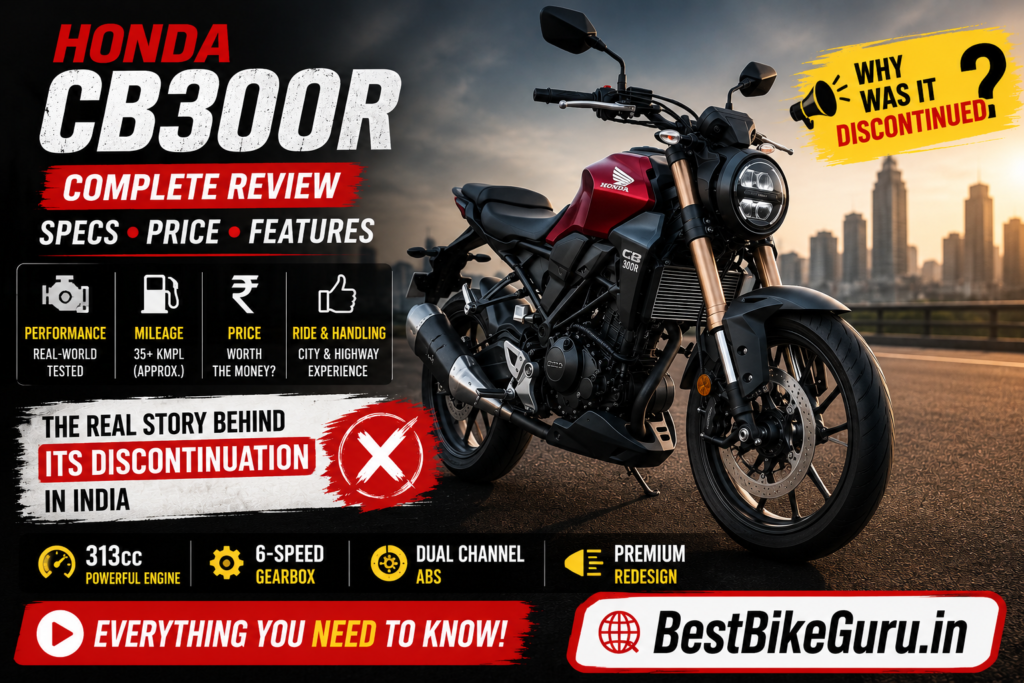
Build Quality: Honda’s Calling Card
Engine refinement is top-notch, and the clutch is very smooth. The bike is user-friendly in heavy traffic, road grip, and power ratio is top class. This owner observation captures something that every CB300R rider mentions: the build quality and refinement feel genuinely premium. Every surface you touch, every panel gap you examine, every bolt you look at it all communicates Honda’s legendary assembly precision. This is a motorcycle that has been built to a standard, not to a price.
Engine & Performance: The Lightweight Pocket Rocket
The 286cc DOHC Unit
| Specification | Detail |
|---|---|
| Displacement | 286.01cc |
| Configuration | Single-Cylinder, Liquid-Cooled, DOHC, 4-Valve |
| Bore x Stroke | 76mm x 63mm |
| Compression Ratio | 10.7:1 |
| Max Power | 31.1 PS @ 9,000 rpm |
| Max Torque | 27.5 Nm @ 7,500 rpm |
| Fuel System | PGM-FI (Honda’s Programmed Fuel Injection) |
| Gearbox | 6-Speed Constant Mesh |
| Clutch | Assist & Slipper |
The 286cc engine is derived from the same architectural DNA as the Honda CBR250R’s 249cc motor but with significant engineering revisions to increase displacement and optimise the power delivery for a naked streetfighter character rather than a fairinged sportbike.
Engine Character: Rev-Happy and Refined
The performance characteristic is distinctly rev-happy; the engine feels most alive past 6,000 rpm, pulling cleanly to its redline. In city traffic, the tractable low-end torque is adequate, and the light action of the slip-assist clutch significantly reduces rider fatigue during stop-and-go commutes.
This is an accurate and honest description. The CB300R’s engine is not a torque monster at low revs it rewards riders who enjoy using the gearbox, exploring the upper rev range, and feeling the engine come alive as the tachometer climbs. The DOHC 4-valve configuration allows the engine to breathe freely at high rpm, giving it a top-end urgency that single-overhead-cam engines at this displacement cannot match.
The power delivery is linear and predictable never aggressive or sudden. Honda has tuned this engine for accessible performance rather than maximum drama. The CB300R is an absolute joy to ride, with an incredible power-to-weight ratio. Its 286cc liquid-cooled, single-cylinder engine produces 31 PS and 27.5 Nm of torque. At just 146 kg, it feels like a pocket rocket.
The Power-to-Weight Ratio Advantage
At 146 kg kerb weight and 31.1 PS, the CB300R’s power-to-weight ratio of 213 PS/tonne is exceptional better than many motorcycles producing significantly more absolute power but carrying significantly more weight. In real-world riding, this translates to acceleration feel and agility that consistently surprises riders who expect a 286cc bike to feel small and underpowered.
Performance Numbers
| Metric | Figure |
|---|---|
| 0–60 kmph | ~4.0–4.5 seconds |
| 0–100 kmph | ~6.5 seconds |
| Top Speed | ~148–150 kmph |
| Comfortable Highway Cruise | 90–110 kmph |
Real-World Mileage
| Condition | Mileage |
|---|---|
| City (Soft Throttle) | 33–36 kmpl |
| City (Mixed) | 28–32 kmpl |
| Highway | 34–36 kmpl |
| Owner Average | 30–32 kmpl |
The mileage figures are honest and competitive for a liquid-cooled DOHC 286cc engine. The 9.7-litre fuel tank the smallest in the segment gives a real-world range of approximately 290–350 km per fill, which is the CB300R’s most significant practical limitation for touring riders.
The Assist & Slipper Clutch
The assist and slipper clutch makes the CB300R exceptionally easy to ride in city traffic the lever pull is notably light, reducing hand fatigue during prolonged stop-and-go riding. During downshifts, the slipper function prevents rear wheel hop by allowing the clutch to partially slip, giving smoother, more controlled deceleration. This feature significantly improves the confidence and safety margin for newer riders who are still developing their throttle and braking finesse.
Suspension & Braking: Where the CB300R Genuinely Excels
This is where the CB300R separates itself from the competition most clearly and where Honda’s engineering quality is most evident.
Front Suspension: Showa SFF-BP USD Forks
| Component | Specification |
|---|---|
| Type | 41mm SFF-BP (Separate Function Front Fork Big Piston) |
| Brand | Showa |
| Travel | 130mm |
| Compression Damping | Fixed |
| Rebound Damping | Fixed |
The SFF-BP (Separate Function Front Fork Big Piston) is a premium fork design where the compression and rebound damping functions are handled by separate fork legs compression on one side, rebound on the other. This separation allows each function to be optimised independently, resulting in better damping characteristics than conventional combined-function forks. The “Big Piston” designation refers to a larger damping piston that provides more precise, linear damping response across the fork’s full travel range.
This is Honda’s own premium suspension technology it is not simply a branded Showa fork but a specifically engineered unit that reflects significant development investment. Premium Showa suspension offers excellent stability and feedback during cornering.
Rear Suspension: Pro-Link Monoshock
Honda’s Pro-Link rear monoshock features a progressive linkage ratio the suspension becomes progressively stiffer as it compresses, providing a plush initial response for small bumps while resisting bottoming out under heavy compression. The 5-way preload adjustability allows riders to fine-tune the rear spring preload for their weight, though rebound damping is fixed. Overall suspension tune is on the firm side consistent with the CB300R’s sporting character but not uncomfortably stiff for regular road use.
Braking: Radially-Mounted 4-Piston Nissin Caliper
| Component | Specification |
|---|---|
| Front Disc | 296mm Floating |
| Front Caliper | Radially-Mounted, 4-Piston Nissin |
| Rear Disc | 220mm |
| ABS | IMU-Based Dual-Channel |
The radially-mounted 4-piston Nissin caliper at the front is genuinely premium hardware. Radial mounting where the caliper bolts to the fork leg parallel to the disc rotation axis rather than perpendicular provides a more rigid caliper-to-fork connection, reducing flex under hard braking and improving braking feel and modulation. This type of caliper is typically found on superbikes and high-performance sportbikes. Finding it on a 286cc motorcycle at ₹2.40 lakh is extraordinary.
The IMU-based dual-channel ABS adds a layer of safety sophistication. An IMU (Inertial Measurement Unit) measures the motorcycle’s lean angle and adjusts ABS intervention accordingly providing more nuanced, appropriate braking intervention in corners compared to a standard speed-sensor-only ABS system.
Handling: The CB300R’s Greatest Strength
Handling is where the Honda CB300R earns its strongest praise from every rider who has spent meaningful time on it. The combination of the lightweight 146 kg chassis, premium Showa suspension, and radial front caliper creates a handling package that genuinely feels like a much larger, more expensive motorcycle.
The CB300R’s standout strength is its exceptional power-to-weight ratio, stemming from a kerb weight of just 146 kg, which translates into remarkable agility and handling.
In city traffic, the 146 kg weight makes the CB300R one of the most effortless motorcycles to manoeuvre U-turns, tight parking situations, slow-speed filtering all feel natural and unstressed. On open roads and weekend spirited runs, the premium suspension and stiff chassis provide corner-entry confidence and mid-corner stability that riders consistently describe as a revelation. The CB300R simply goes where you point it, without drama or protest.
One honest concern noted by some owners: the bike being light in weight, high wind speeds can make it feel slightly less planted at speeds above 80 kmph the lightweight chassis that makes it so agile at slower speeds can occasionally feel less planted in strong crosswinds at highway speeds. This is a physics reality of lightweight chassis design rather than an engineering flaw, but it is worth knowing for riders who frequently ride in windy conditions.
Why Was the CB300R Discontinued in India? The Full Story
This is the question every CB300R admirer is asking and the honest answer is both straightforward and sobering.
Sales Were Simply Too Low
Honda sold only one CB300R in the three months from March to May 2025. Dealers confirmed the bike has been discontinued, and it has been removed from the official Honda BigWing website.
A motorcycle selling one unit in three months is not commercially viable for any manufacturer. The question is why a technically excellent motorcycle was selling so poorly.
Limited Distribution: The BigWing Problem
The CB300R was sold exclusively through Honda’s BigWing dealership network Honda’s premium showroom format for motorcycles above 300cc. The CB300R’s availability was restricted to select cities and select dealerships, whereas rivals like the Triumph Speed 400 and Royal Enfield Guerrilla 450 are available across the country.
India has approximately 100+ BigWing dealerships compared to Bajaj’s 3,000+ outlets, TVS’s 4,000+ outlets, and Hero’s 6,000+ service touchpoints. A buyer in a Tier 2 or Tier 3 city who wanted a CB300R could not simply visit a nearby dealer they had to travel, often significantly, to access one. For a purchase this size, that friction matters.
The Pricing Challenge
At ₹2.40 lakh, the CB300R was priced against some formidable rivals. The Triumph Speed 400 at ₹2.23 lakh offered 40 PS 9 PS more with Triumph’s global brand prestige. The Royal Enfield Guerrilla 450 at ₹2.49 lakh offered 40 PS, a more advanced liquid-cooled DOHC motor, ride modes, and RE’s legendary community and service reach. The Bajaj Pulsar NS400Z at ₹1.80 lakh offered 40.6 PS with a bidirectional quickshifter, 4 ride modes, and a TFT display equivalent.
Against these rivals, the CB300R’s 31.1 PS, absence of ride modes, and LCD display began to look like relative disadvantages even though its handling quality and engineering refinement were arguably superior to all of them.
What Autocar India Said
Honda hasn’t specified any reason for the removal of the CB300R from its lineup. One possibility is that Honda could be making way for the long-awaited Rebel 300. Having two bikes with the same 286cc engine at similar price points could cause cannibalisation.
The Rebel 300 theory is credible Honda’s globally popular cruiser-styled Rebel 300 uses the same 286cc engine and has long been anticipated for the Indian market. If Honda is indeed planning a Rebel 300 launch through BigWing, discontinuing the CB300R first makes strategic sense.
What Owners Say: Real-World Experience After 2500+ km
The most valuable perspective on any motorcycle comes from people who have actually lived with it. Here is a synthesis of real owner experiences from Team-BHP, ZigWheels, BikeDekho, and other platforms:
What Owners Love
Engine refinement: Nearly every long-term owner mentions the engine’s exceptional refinement and smooth power delivery as the CB300R’s defining characteristic. It has never let me down. The performance is outstanding, and the looks are truly exceptional.
Handling precision: The consensus among owners who ride regularly on weekend spirited runs is that the CB300R handles better than any motorcycle they have ridden at this price. The Showa suspension and lightweight chassis combination is consistently praised.
Build quality: Honda’s assembly quality, fit-finish, and long-term reliability receive consistent five-star reviews. Owners report zero major mechanical issues even past 20,000 km.
Fuel efficiency: Real-world mileage of 30–36 kmpl is considered excellent for the engine’s performance level, with some careful riders reporting even higher figures on highway runs.
Also Read : Aprilia Bike 457 The Italian Sports Beast That India Was Waiting For!
What Owners Wish Were Different
Fuel tank size: The 9.7-litre tank is the most consistently cited frustration. At 30–32 kmpl average, it limits range to approximately 290–310 km requiring more frequent fuel stops than most rivals.
Price perception: Multiple owners acknowledge that at ₹2.40 lakh, the CB300R felt expensive compared to rivals offering more power and features, even while agreeing it offered superior quality and riding experience.
Limited availability: The BigWing-only distribution was a frustration even for those who managed to buy one for after-sales service, owners in smaller cities had to travel significant distances to BigWing centres.
No ride modes or TFT: In a market where even ₹1.80 lakh motorcycles offer TFT displays and multiple ride modes, the CB300R’s LCD instrument cluster and absence of electronic riding aids felt like an omission at its price point.
Key Features Overview
| Feature | Status |
|---|---|
| 41mm Showa SFF-BP USD Forks | Standard |
| Pro-Link Rear Monoshock (5-way preload) | Standard |
| Radially-Mounted 4-Piston Nissin Front Caliper | Standard |
| IMU-Based Dual-Channel ABS | Standard |
| Assist & Slipper Clutch | Standard |
| Full LED Lighting (Head, Tail, Indicators) | Standard |
| LCD Digital Instrument Cluster | Standard |
| Gear Position Indicator | Standard |
| PGM-FI Fuel Injection | Standard |
| Underslung Upswept Exhaust | Standard |
| Brushed Alloy Radiator Shrouds | Standard |
| OBD-2B Compliance | Standard |
| TFT Display | Not Available |
| Ride Modes | Not Available |
| Traction Control | Not Available |
| Bluetooth Connectivity | Not Available |
| Quickshifter | Not Available |
On-Road Price Reference (Last Known, 2025)
| City | Last Known Ex-Showroom | Estimated On-Road |
|---|---|---|
| Delhi | ₹2,40,000 | ₹2,74,000 |
| Mumbai | ₹2,40,000 | ₹2,79,000 |
| Bangalore | ₹2,40,000 | ₹2,71,000 |
| Chennai | ₹2,40,000 | ₹2,69,000 |
| Hyderabad | ₹2,40,000 | ₹2,72,000 |
These are last-known prices before discontinuation. New units are no longer available. Used/certified pre-owned units at BigWing dealerships may still be found.
Competitor Comparison: How the CB300R Stacked Up
| Feature | Honda CB300R | Triumph Speed 400 | RE Guerrilla 450 | Bajaj NS400Z |
|---|---|---|---|---|
| Price | ₹2.40 L | ₹2.23 L | ₹2.49 L | ₹1.80 L |
| Engine | 286cc, DOHC, Liquid | 398cc, DOHC, Liquid | 452cc, DOHC, Liquid | 349cc, DOHC, Liquid |
| Power | 31.1 PS | 40 PS | 40 PS | 40.6 PS |
| Torque | 27.5 Nm | 37.5 Nm | 40 Nm | 33.2 Nm |
| Weight | 146 kg | 176 kg | 185 kg | 174 kg |
| Front Suspension | 41mm Showa USD | 43mm USD | Telescopic | 43mm USD |
| Front Caliper | 4-Piston Nissin Radial | 2-Piston | 2-Piston | 2-Piston |
| IMU ABS | Yes | No | No | No |
| Ride Modes | No | No | Yes (2) | Yes (4) |
| TFT Display | No | Yes | Yes | No (LCD) |
| Quickshifter | No | No | No | Yes (Bidir.) |
| Fuel Tank | 9.7 L | 13 L | 11 L | 12 L |
| Mileage | 30–32 kmpl | 30 kmpl | 29 kmpl | 28–32 kmpl |
| Power-to-Weight | 213 PS/T | 227 PS/T | 216 PS/T | 233 PS/T |
| User Rating | 4.4/5 | 4.5/5 | 4.4/5 | 4.7/5 |
The comparison table tells the honest story of why the CB300R struggled commercially. On paper power, torque, features, fuel tank it trails every rival. Yet on the qualities that matter most to experienced riders suspension quality, caliper quality, lightweight agility, build refinement, and IMU-based ABS it is genuinely class-leading. The tragedy of the CB300R is that the qualities it excels at are harder to communicate in a spec sheet than power and torque figures.
Should You Buy a Used Honda CB300R?
Given its discontinuation, the question for many interested buyers has shifted from “Should I buy a new one?” to “Is a used CB300R worth it?” The answer depends on several factors.
Reasons to Consider a Used Honda CB300R
- Exceptional long-term reliability Honda’s engineering quality means well-maintained examples will remain mechanically sound for many years
- Depreciation advantage discontinued models often depreciate faster initially, potentially offering better value in the used market
- Unmatched handling at the price the Showa SFF-BP forks and radial Nissin caliper combination is still among the best in its price class even as a used motorcycle
- BigWing certified pre-owned programmes Honda’s BigWing network offers certified pre-owned inspections and limited warranties
Also Read : TVS Jupiter 125 Complete Review 2026 | Price, Mileage, Features & Specs
Important Cautions for Used CB300R Buyers
- 2025 headlight recall a 2025 recall affecting certain CB300R units due to a headlight PCB defect was issued. Verify that any used unit you consider has had the recall repair completed via Honda customer care
- Service accessibility with BigWing-only servicing, owning a Honda CB300R in a city without a BigWing dealership means travelling for every service visit
- Spare parts availability with the model discontinued, parts availability will gradually reduce over time. For an older unit with high mileage, this is a meaningful long-term concern
- Limited resale a discontinued model typically has a weaker resale market than an actively sold model
Best Alternatives to the Honda CB300R
If the CB300R’s character appeals to you lightweight, premium, refined, handling-focused here are the best alternatives currently available in India:
| Alternative | Price | Why Consider It |
|---|---|---|
| Triumph Speed 400 | ₹2.23 L | More power (40 PS), lighter at 176 kg, Triumph badge, better resale |
| RE Guerrilla 450 | ₹2.49 L | Most powerful (40 PS), ride modes, TFT, RE’s massive service network |
| Bajaj Pulsar NS400Z | ₹1.80 L | Best value (40.6 PS, quickshifter, 4 modes) radically cheaper |
| KTM 390 Duke | ₹3.00 L | Sharpest performance character, TFT, most premium but significantly pricier |
| Honda CB350 / CB350RS | ₹2.10–2.33 L | Honda reliability, air-cooled 350cc, better BigWing network support, more practical |
Honda CB300R Pros
- Most premium suspension hardware in segment Showa SFF-BP 41mm USD forks
- Radially-mounted 4-piston Nissin front caliper superbike-grade braking hardware
- IMU-based dual-channel ABS most sophisticated safety electronics in class
- Exceptional power-to-weight ratio at 213 PS/tonne from just 146 kg
- Honda’s legendary build quality fit, finish, and long-term reliability are exemplary
- Neo Sports Café design one of the most visually distinctive, premium-looking motorcycles at any price in its era
- Assist & slipper clutch light lever pull, smooth downshifts
- Underslung upswept exhaust functional design element that enhances ground clearance and aesthetics
- Rev-happy DOHC engine that rewards riders who explore the upper rev range
Honda CB300R Cons
- Discontinued in India no new units available; used market only
- 9.7-litre fuel tank smallest in segment, limits touring range to ~290–310 km
- No ride modes, traction control, or TFT display missing modern electronics rivals offer at lower prices
- Only 31.1 PS trails all major rivals by 9–10 PS despite higher or similar pricing
- BigWing-only service extremely limited service accessibility, particularly outside major cities
- 157mm ground clearance low; careful with speed breakers and rough road crossings
- 2025 headlight recall verify repair completion on any used unit
- Weak resale discontinued status reduces buyer pool and resale value
Final Rating
| Category | Score |
|---|---|
| Design & Styling | 9.5 / 10 |
| Engine & Performance | 7.5 / 10 |
| Suspension & Braking | 9.5 / 10 |
| Handling & Chassis | 9.5 / 10 |
| Features & Technology | 6.5 / 10 |
| Practical Usability | 7.0 / 10 |
| Value for Money | 7.0 / 10 |
| Overall | 8.1 / 10 |
A Brilliant Bike That India Wasn’t Ready For
The Honda CB300R is a motorcycle that will be remembered by every rider who owned one with genuine affection. It was never the most powerful, never the most feature-loaded, never the cheapest. But it was and remains one of the most beautifully engineered, most satisfying to ride, and most premium-feeling motorcycles that the Indian sub-₹3 lakh segment has ever seen.
Its commercial failure in India was not a failure of engineering. It was a failure of distribution strategy, pricing positioning, and market timing. In a segment increasingly defined by power figures, feature lists, and social media specs, the CB300R’s strengths suspension quality, caliper quality, IMU ABS, build refinement, handling feel were real but difficult to communicate to buyers who were comparing spec sheets.
If you find a well-maintained used CB300R at a fair price verify the headlight recall is resolved, confirm service records, check BigWing accessibility in your city it remains a genuinely special machine worth owning. If you are looking for a new motorcycle today, the Triumph Speed 400 or Royal Enfield Guerrilla 450 are the most natural alternatives for buyers who appreciate what the CB300R stood for.
The CB300R deserved more. India’s loss is the used motorcycle market’s gain.
Honda CB300R FAQ
Is the Honda CB300R still available to buy in India in 2026?
No. Honda has silently removed the CB300R from its official BigWing website, with dealers confirming no unsold stock remains and no further bookings being taken. Only used or certified pre-owned units are available through BigWing dealerships.
Why was the Honda CB300R discontinued in India?
Multiple factors: very low sales (one unit sold in three months in 2025), extremely limited BigWing distribution network, pricing pressure from stronger rivals, and a possible portfolio restructuring to make way for the Rebel 300 which shares the same 286cc engine.
What was the last price of the Honda CB300R in India?
The last recorded ex-showroom price was ₹2.40 lakh (Delhi). On-road price in Delhi was approximately ₹2.74 lakh including RTO, insurance, and handling charges.
What engine does the Honda CB300R use?
A 286.01cc, single-cylinder, liquid-cooled, DOHC, 4-valve engine producing 31.1 PS at 9,000 rpm and 27.5 Nm at 7,500 rpm, mated to a 6-speed gearbox with an assist and slipper clutch.
What is the real-world mileage of the Honda CB300R?
Owner-reported real-world mileage ranges between 30–36 kmpl. City riding with mixed throttle returns approximately 28–32 kmpl; relaxed highway riding can achieve 34–36 kmpl.
What recall affected the Honda CB300R?
A 2025 recall was issued for certain CB300R units due to a headlight PCB defect. Buyers considering used units should verify with Honda customer care whether the recall repair has been completed on their specific VIN.
Is a used Honda CB300R worth buying?
For riders in cities with Honda BigWing dealerships who prioritise handling quality and engineering refinement over features and power yes. Verify recall completion, service history, and BigWing service accessibility in your city before purchasing.