
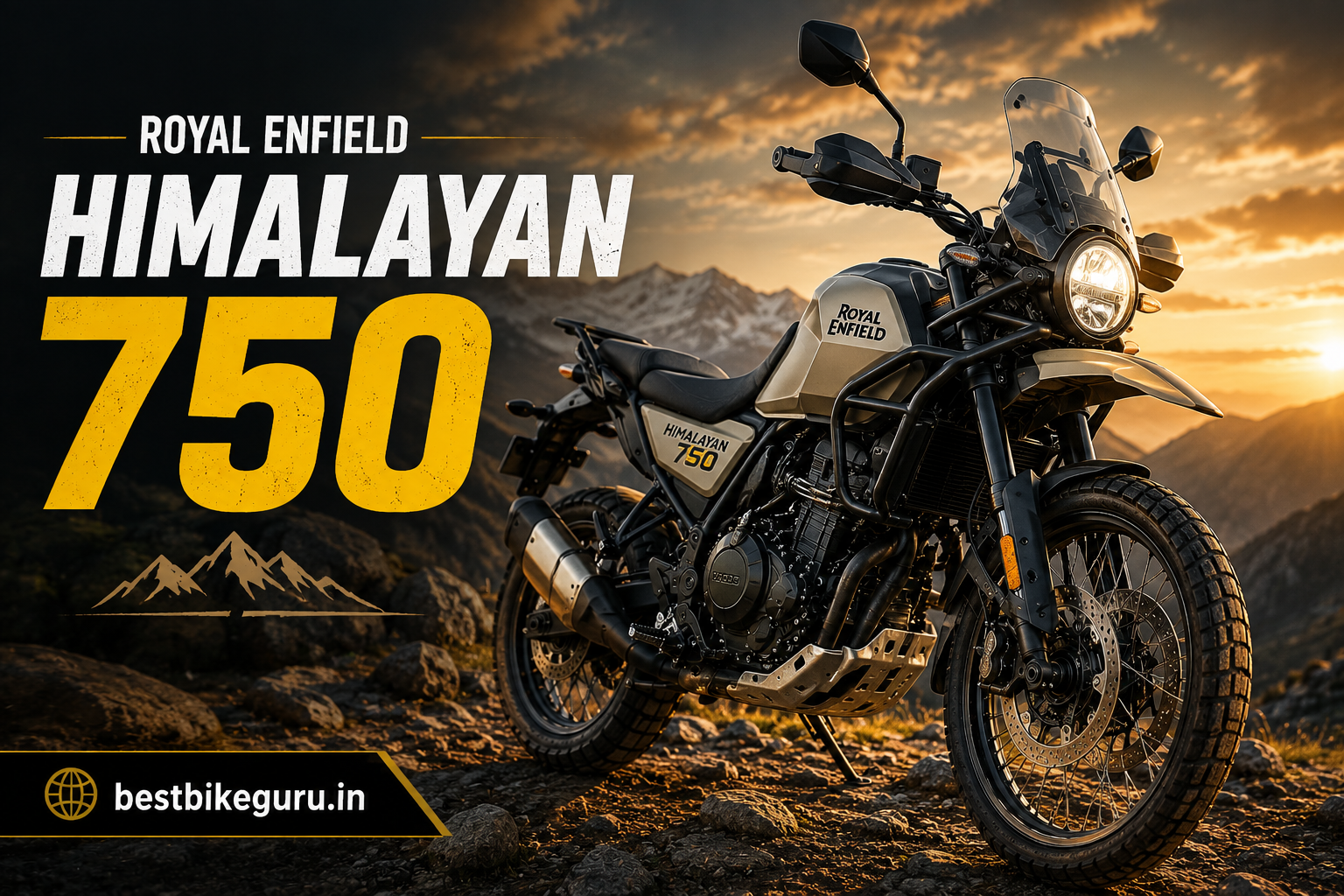
Royal Enfield Himalayan 750 – expected price ₹4.50 lakh, 750cc parallel-twin engine, 55 PS power, spy shots, launch timeline, rival comparison vs Himalayan 450, KTM 390 Adventure, Kawasaki Versys 650. Everything in one place.
If you follow the Indian motorcycle market closely, there is one name that has dominated adventure bike conversations throughout 2025 and 2026: the Royal Enfield Himalayan 750. Not because it is already here — it isn’t, not officially — but because of what it promises to be. And what it promises to be is genuinely significant.
The Royal Enfield Himalayan has been one of India’s most beloved adventure motorcycles since its original launch in 2016. Through its various iterations — including the major overhaul with the Himalayan 450 — the nameplate has built a deeply loyal following among Indian touring riders. But for a certain type of rider, the Himalayan 450’s single-cylinder engine, while competent, has always felt like a ceiling they wanted to break through. More power, more refinement, more touring capability — without leaving the Himalayan family.
That ceiling is about to be smashed.
The Royal Enfield Himalayan 750 takes everything the Himalayan stands for — rugged adventure capability, accessible ergonomics, trusted Royal Enfield reliability — and combines it with a bored-out 750cc parallel-twin engine, fully adjustable long-travel suspension, dual front disc brakes, and a tech package that puts it firmly in the middleweight adventure tourer category. Spy shots from May 2026 showing the bike fitted with panniers and a headlight guard — full accessories that typically appear only when a launch is imminent — have set the enthusiast community alight.
Expected to debut globally at EICMA 2026 in November and launch in India shortly after, with pricing estimated at ₹4.50 lakh (ex-showroom), the Himalayan 750 could be the most important Royal Enfield launch in years. Here is everything we know.
Quick Snapshot: Royal Enfield Himalayan 750 at a Glance
| Feature | Expected Details |
|---|---|
| Expected India Launch | Late 2026 / Early 2027 |
| Global Debut | EICMA 2026, November (Expected) |
| Expected Starting Price | ₹4.50 Lakh (Ex-Showroom) |
| Engine | 750cc, Air/Oil-Cooled, Parallel-Twin |
| Expected Power | 55–60 PS @ ~8,000 rpm |
| Expected Torque | 60–65 Nm @ ~6,500 rpm |
| Transmission | 6-Speed Manual |
| Front Suspension | Long-Travel USD Forks (Fully Adjustable) |
| Rear Suspension | Monoshock (Fully Adjustable) |
| Front Wheel | 19-inch Spoke |
| Rear Wheel | 17-inch Spoke |
| Front Brake | Dual Disc (320mm) |
| Rear Brake | Single Disc (260mm) |
| ABS | Dual-Channel, with Off-Road Mode |
| Expected Fuel Tank | 17–18 Litres |
| Expected Kerb Weight | ~205–215 kg |
| Expected Seat Height | ~850–870 mm |
| Expected Mileage | 28–33 kmpl |
| Display | Tripper Dash TFT with Google Maps |
| Riding Modes | 3+ Expected |
All figures based on spy shots, confirmed teasers, and credible industry reports. Official specs will be confirmed at launch.
The Story So Far: How the Himalayan 750 Came to Be
To understand why the Himalayan 750 matters so much, you need to understand the journey that led here.
Royal Enfield’s 650cc parallel-twin platform — launched in 2018 with the Interceptor 650 and Continental GT 650 — was a transformative moment for the brand. For the first time, Royal Enfield was building a genuinely modern, refined parallel-twin engine that could compete with international machinery on merit. That platform has since grown into the brand’s most versatile architecture, powering seven different models including the Super Meteor 650, Shotgun 650, Bear 650, Classic 650, and Bullet 650.
The question was always: when does the Himalayan get this engine?
The answer came in stages. First, Royal Enfield’s Lead Designer Steve Everitt confirmed to MCN that a twin-cylinder Himalayan was in development — and critically, that it would not replace the existing Himalayan 450 but complement it, targeting riders who hadn’t connected with the single-cylinder character. Then came the official tease: Royal Enfield releasing images of the Himalayan 750 and Himalayan Electric being tested in the high-altitude terrains of Ladakh — some of the most demanding real-world testing grounds on the planet.
The Ladakh testing carries symbolic weight too. Ladakh has always been the Himalayan’s spiritual home — the route that defined its identity and built its legend among Indian touring riders. Testing the 750 there is Royal Enfield telling the world: this bike is ready for the real thing.
By May 2026, test mules were spotted on Indian roads fitted with panniers and headlight guards — accessories that the product team attaches during pre-launch validation. Every experienced observer of the motorcycle industry knows what that means. The engineering is done. The launch is coming.
Design & Styling: Evolution, Not Revolution
Royal Enfield has never been a brand that makes radical visual breaks between generations. The Himalayan 750 follows this philosophy — it is an evolutionary design over the Himalayan 450, but with several key upgrades that signal its larger, more touring-focused character.
The Half-Fairing
The most visually distinctive element of the Himalayan 750 is its new, larger half-fairing. Compared to the Himalayan 450’s more compact front section, the 750’s fairing is wider and more encompassing — it wraps further around the handlebars and offers better wind protection at highway speeds. Combined with the taller, wider windscreen, this gives the bike a more substantial, premium touring presence that clearly differentiates it from its smaller sibling.
LED Headlamp Cluster
The Himalayan 750 retains the LED headlamp design familiar from the Himalayan 450 — a round LED unit that carries the Himalayan’s characteristic look. The headlight guard spotted on the May 2026 test mule is expected to be part of the official accessories catalogue, allowing riders to protect the lamp on off-road sections.
Upswept Exhaust
Spy shots reveal an upswept exhaust system — a departure from the more conventional routing of the Himalayan 450. The upswept design increases ground clearance on the exhaust side, improving off-road capability, while also giving the bike a more purposeful, adventure-oriented visual identity.
Wide Handlebars, Split Seats, and Luggage Mounts
The familiar Himalayan adventure DNA carries through: wide handlebars for excellent leverage and control, split seats optimised for touring comfort, chunky grab rails for pillion passengers, and integrated luggage mounting points for panniers and top boxes. The pannier fitment observed in May 2026 spy shots confirms that hard panniers will be available as official Royal Enfield accessories.
Wheel Configuration: A Significant Shift
This is one of the most debated design decisions surrounding the Himalayan 750. Where the Himalayan 450 uses a 21-inch front wheel — optimised for genuine off-road capability — the Himalayan 750 is expected to feature a 19-inch front wheel paired with a 17-inch rear.
This is not a compromise; it is a deliberate statement of intent. A 19-inch front wheel offers a better balance between on-road handling stability and off-road capability. It tells you that the Himalayan 750 is conceived primarily as a road-biased adventure tourer — a machine for covering serious distances across varied tarmac conditions, with sufficient capability for light-to-moderate off-road use. Riders who want to tackle technical single-track trails will likely prefer the 450. Riders who want to eat up highways and national highways with occasional gravel diversions will be better served by the 750.
Fuel Tank Size
The expected fuel tank capacity of 17–18 litres is a meaningful upgrade over the Himalayan 450’s 17-litre tank. Combined with an expected mileage of 28–33 kmpl, riders can realistically expect a highway range of 500+ km per tank — genuinely long-distance touring capability.
Engine & Performance: The 750cc Twin Is the Real Story
What We Know About the Engine
The heart of the Himalayan 750 is its new 750cc, air/oil-cooled, parallel-twin engine — and this is not simply the existing 648cc unit with a larger bore. Royal Enfield has confirmed it is a re-engineered unit with both a larger bore and longer stroke, specifically tuned for the character and demands of an adventure tourer.
Steve Everitt’s confirmation to MCN was clear: the engine is “tuned for its job.” What that means in practice is an engine that prioritises low-end and mid-range torque over peak power. An adventure tourer doesn’t need to scream to 12,000 rpm to feel exciting — it needs effortless, confident power available from low revs, whether pulling out of a tight hairpin in the mountains or overtaking on a national highway cruise.
Expected Power Figures
| Specification | Expected Figure |
|---|---|
| Displacement | 750cc |
| Configuration | Parallel-Twin, Air/Oil-Cooled |
| Max Power | 55–60 PS @ ~8,000 rpm |
| Max Torque | 60–65 Nm @ ~6,500 rpm |
| Gearbox | 6-Speed, Re-geared for mid-range punch |
| Clutch | Slip & Assist (Expected) |
For context, the existing 648cc engine produces 47 PS and 52 Nm. The 750cc unit is expected to bring approximately 8–13 PS more power and 8–13 Nm more torque — a meaningful performance step that will be felt most clearly at highway speeds and during loaded touring.
How Will It Feel?
Based on the engine philosophy described by Royal Enfield’s team and the expected tuning, the 750cc twin should feel noticeably more relaxed and effortless than the 450’s single-cylinder unit. Where the Himalayan 450’s motor has to work to maintain 100–110 kmph highway pace, the 750’s twin should cruise at those speeds with revs well within the comfortable mid-range, leaving a significant reserve for overtaking or handling uphill grades with a fully loaded panniers and a pillion.
The parallel-twin configuration also eliminates most of the single-cylinder vibrations that some Himalayan 450 riders note at higher speeds — a significant comfort improvement for multi-day touring.
Riding Modes
The Himalayan 750 is expected to feature at least 3 riding modes, likely including:
| Mode | Character |
|---|---|
| Road | Full power, normal ABS, stability-focused |
| Off-Road | Reduced ABS intervention, more rear wheel freedom |
| Rain/Eco | Reduced power, maximum traction control |
A dedicated off-road ABS mode — where rear ABS can be partially disengaged for controlled slides on gravel — has been mentioned in credible reports and is consistent with the bike’s adventure-tourer positioning.
Suspension & Braking: Premium All Around
Suspension Setup
The Himalayan 750 is expected to feature a significant upgrade over the 450 in terms of suspension quality and adjustability:
| Component | Expected Specification |
|---|---|
| Front | Long-Travel USD Forks, Fully Adjustable |
| Front Travel | ~180 mm |
| Rear | Monoshock, Fully Adjustable |
| Rear Travel | ~170 mm |
| Remote Preload Adjuster | Yes (visible in spy shots) |
The remote preload adjuster dial spotted in spy shots is a premium feature — it allows riders to instantly adjust the rear suspension preload setting without tools, compensating for luggage weight or pillion presence. This kind of feature is typically found on motorcycles significantly more expensive than the Himalayan 750’s expected price point.
Braking: Dual Front Discs
This is a first for a Royal Enfield ADV — the Himalayan 750 is expected to feature dual disc brakes at the front. This upgrade is necessitated by the increased power and weight of the 750cc platform and brings the braking capability in line with what serious touring riders expect. The expected brake specifications:
| Position | Specification |
|---|---|
| Front | Dual Disc, 320mm |
| Rear | Single Disc, 260mm |
| ABS | Dual-Channel, with switchable Off-Road Mode |
Features & Technology: Modern ADV Essentials
The Himalayan 750 is expected to be Royal Enfield’s most feature-complete adventure motorcycle to date. Based on confirmed teasers, spy shots, and credible industry reports:
Expected Feature List
| Feature | Status |
|---|---|
| Tripper Dash TFT Display | Confirmed via spy shots |
| Google Maps Integration | Expected (standard on Tripper units) |
| Bluetooth Connectivity | Expected |
| Cruise Control | Expected |
| Multiple Riding Modes | Expected (3+) |
| Dual-Channel ABS with Off-Road Mode | Expected |
| Traction Control | Expected |
| Fully Adjustable Suspension | Expected |
| Remote Preload Adjuster | Confirmed via spy shots |
| Dual Front Disc Brakes | Confirmed via spy shots |
| Pannier Mounting Points | Confirmed via spy shots |
| Headlight Guard (Accessory) | Confirmed via spy shots |
| USB Charging Port | Expected |
| LED Lighting (Full) | Expected |
| Slipper & Assist Clutch | Expected |
The Tripper Dash TFT — Royal Enfield’s connected navigation display — has been a significant differentiator for the brand’s premium models. On the Himalayan 750, it is expected to feature Google Maps integration that works in conjunction with the smartphone app, giving real-time turn-by-turn navigation optimised for touring.
Expected Price & On-Road Costs
The most credible industry estimates place the Himalayan 750’s starting price at approximately ₹4.50 lakh (ex-showroom), with the possibility of multiple variants that could push higher-spec models above ₹5 lakh.
Expected Ex-Showroom & On-Road Price (City-Wise)
| City | Expected Ex-Showroom | Estimated On-Road |
|---|---|---|
| Delhi | ₹4.50 Lakh | ₹5.00–5.15 Lakh |
| Mumbai | ₹4.50 Lakh | ₹5.10–5.25 Lakh |
| Bangalore | ₹4.50 Lakh | ₹4.95–5.10 Lakh |
| Chennai | ₹4.50 Lakh | ₹4.90–5.05 Lakh |
| Hyderabad | ₹4.50 Lakh | ₹4.95–5.10 Lakh |
| Pune | ₹4.50 Lakh | ₹4.98–5.13 Lakh |
These are estimates based on expected pricing. Actual on-road prices will depend on confirmed ex-showroom price, local RTO charges, insurance costs, and dealer charges.
EMI Estimate (Indicative)
| Loan Tenure | Down Payment (20%) | Monthly EMI (Approx. @ 8.5%) |
|---|---|---|
| 12 Months | ₹90,000 | ₹31,500 |
| 24 Months | ₹90,000 | ₹16,400 |
| 36 Months | ₹90,000 | ₹11,300 |
| 48 Months | ₹90,000 | ₹8,700 |
Competitor Comparison: Where Does the Himalayan 750 Sit?
The Himalayan 750’s expected positioning at ₹4.50 lakh places it in an interesting gap in the Indian market — above the affordable ADV segment but below the premium European machines.
Competitor Comparison Table
| Feature | RE Himalayan 750 | RE Himalayan 450 | KTM 390 Adventure | Kawasaki Versys X 300 | Kawasaki Versys 650 |
|---|---|---|---|---|---|
| Price | ₹4.50 L* | ₹3.06 L | ₹3.97 L | ₹3.49 L | ₹8.63 L |
| Engine | 750cc Twin | 452cc Single | 399cc Single | 296cc Twin | 649cc Twin |
| Power | 55–60 PS* | 40 PS | 46 PS | 39 PS | 67 PS |
| Torque | 60–65 Nm* | 40 Nm | 39 Nm | 27 Nm | 63 Nm |
| Weight | ~210 kg* | 196 kg | 185 kg | 172 kg | 218 kg |
| Front Wheel | 19-inch | 21-inch | 21-inch | 19-inch | 17-inch |
| Adj. Suspension | Yes (Expected) | No | No | No | No |
| Dual Front Disc | Yes (Expected) | No | No | No | Yes |
| TFT Display | Yes | Yes | Yes | No | No |
| Cruise Control | Yes* | Yes | Yes | No | No |
*Expected/estimated figures
Himalayan 750 vs Himalayan 450: Should You Wait?
This is the question most current Himalayan 450 owners and prospective buyers are wrestling with. Here is the honest breakdown:
Buy the Himalayan 450 now if:
- You primarily ride technical off-road trails where the 21-inch front wheel advantage is real
- Your budget doesn’t comfortably stretch to ₹4.50 lakh
- You don’t want to wait potentially 6–12 more months for the 750 to launch and reach showrooms
- You prefer a lighter, more nimble single-cylinder character
Wait for the Himalayan 750 if:
- Highway touring is your primary use case and you want effortless twin-cylinder refinement
- You regularly tour fully loaded (panniers + pillion) and want the extra power and torque reserve
- Premium features like dual front discs and fully adjustable suspension matter to you
- You’ve always wanted more from the Himalayan without changing brands
Himalayan 750 vs KTM 390 Adventure
The KTM 390 Adventure at ₹3.97 lakh is the most direct performance-focused rival. The KTM is lighter, more aggressively tuned, and has a class-leading electronics package. However, the Himalayan 750 is expected to offer significantly more displacement and torque, more touring comfort, larger fuel capacity, and the familiar, accessible Royal Enfield character that many Indian riders prefer. At an expected ₹50,000 more than the KTM, the Himalayan 750 will need to justify that premium — and if the 750cc twin delivers on its promise, it very likely will.
Himalayan 750 vs Kawasaki Versys 650
The Versys 650 at ₹8.63 lakh is almost double the price of the expected Himalayan 750. It offers a 649cc twin with 67 PS — more power — but the Himalayan 750 comes close enough on paper while being significantly more affordable, better equipped with modern electronics, and arguably better suited to Indian road conditions. The Versys 650 has the Kawasaki service network advantage, but on pure value, the Himalayan 750 could make the Versys 650 a very difficult proposition for the budget-conscious middleweight tourer buyer.
Launch Timeline: What to Expect and When
| Milestone | Expected Timeline |
|---|---|
| Spy Shots with Panniers (India) | May 2026 — Confirmed |
| Global Debut (EICMA 2026, Milan) | November 2026 — Expected |
| International Market Launch | Late 2026 / Early 2027 |
| India Launch | Late 2026 or Early 2027 |
| Bookings Open (India) | To be announced |
| Deliveries Begin | 2027 (Likely) |
Royal Enfield’s testing cycle in India — from near-production spy shots to launch announcement — typically runs 6 to 9 months. Given that pannier-fitted test mules were photographed in May 2026, a reveal in the second half of 2026 is realistic. The EICMA show in November is the most logical global debut platform.
India deliveries in 2027 appear to be the most realistic scenario, though an aggressive Royal Enfield could surprise with a late 2026 India launch if production readiness allows.
Who Should Buy the Royal Enfield Himalayan 750?
This Bike Is Perfect For You If:
- You are a serious touring rider who covers 500+ km days regularly and wants effortless twin-cylinder performance
- You want Royal Enfield’s trusted reliability and service network wrapped in a significantly more powerful package than the 450
- You ride fully loaded — panniers, top box, pillion — and the single-cylinder Himalayan 450 doesn’t have enough reserve power for comfortable touring
- You want the most premium ADV Royal Enfield has ever built — dual front discs, adjustable suspension, TFT with navigation
- You do the Leh-Manali, Spiti, or Coastal routes and want a machine that handles high-altitude, long-distance terrain without breaking a sweat
- You’ve been looking at the Kawasaki Versys 650 but can’t justify the price — the Himalayan 750 could be your answer
This Bike May Not Be Right If:
- Serious technical off-roading is your primary passion — the 19-inch front wheel and heavier weight make the 450 a better technical trail bike
- You need a motorcycle right now — the Himalayan 750 launch is still months away
- Your budget is firmly under ₹4 lakh — the Himalayan 450 or KTM 390 Adventure are better fits
- You prefer the raw, single-cylinder character and thump that has defined the Himalayan experience for years
Pros & Cons: Based on Everything We Know
Expected Pros
- 750cc parallel-twin engine — the biggest, most refined motor ever in a Royal Enfield ADV
- Dual front disc brakes — a first for the Himalayan line and a necessary upgrade at this power level
- Fully adjustable suspension with remote preload adjuster — touring rider’s dream feature
- Larger 17–18 litre fuel tank for serious range — 500+ km per fill realistic
- Tripper TFT with Google Maps navigation — proper connected touring tech
- Official pannier compatibility confirmed — ready for adventure straight from the showroom
- Expected pricing of ₹4.50 lakh makes it enormously competitive against international parallel-twin ADVs
- Complements rather than replaces the Himalayan 450 — RE is expanding the range, not shrinking it
Expected Cons
- Not yet launched — all specifications are based on estimates and spy shots; confirmed figures may differ
- 19-inch front wheel (vs 450’s 21-inch) limits serious off-road capability
- Heavier than the Himalayan 450 — will be less nimble on technical trails
- Long wait — India launch likely in late 2026 at earliest, possibly 2027
- Royal Enfield’s recent track record on launch delays means timelines could slip further
- No confirmed pricing — ₹4.50 lakh is the most cited estimate but actual price could be higher
Final Verdict: Is the Himalayan 750 Worth Waiting For?
Yes. Unequivocally, for the right rider — yes.
The Royal Enfield Himalayan 750 represents something that Indian motorcycle enthusiasts have wanted for a long time: a genuinely capable middleweight adventure tourer, from a trusted Indian brand, at a price that doesn’t require a second mortgage. If Royal Enfield delivers on the promise of 55–60 PS, 60–65 Nm, fully adjustable suspension, dual front discs, and comprehensive touring tech at ₹4.50 lakh — it will be one of the most compelling motorcycles in the Indian market at any price.
The question of whether to wait for it or buy a Himalayan 450 now is genuinely personal. If you tour heavily, if you want twin-cylinder refinement, if you regularly ride with full luggage — wait. If you love off-roading, if you need a bike now, or if the budget doesn’t stretch — buy the 450 and ride happily.
But if you’ve been waiting for Royal Enfield to build something that truly competes with international middleweight adventure tourers on performance, features, and value simultaneously — your wait is almost over.
Anticipated Rating (Pre-Launch):
| Category | Anticipated Score |
|---|---|
| Design & Styling | 9.0 / 10 |
| Engine & Performance | 9.0 / 10 |
| Features & Technology | 9.0 / 10 |
| Touring Capability | 9.5 / 10 |
| Value for Money | 9.5 / 10 |
| Off-Road Capability | 7.0 / 10 |
| Overall (Anticipated) | 8.8 / 10 |
Royal Enfield Himalayan 750 FAQ
What is the expected price of the Royal Enfield Himalayan 750 in India?
The most widely cited estimate is approximately ₹4.50 lakh (ex-showroom). Some sources suggest a range of ₹4.00–₹5.00 lakh depending on variant. Official pricing will be confirmed at launch.
When will the Royal Enfield Himalayan 750 launch in India?
The most likely timeline is a global debut at EICMA in November 2026, with India launch following in late 2026 or early 2027. Given Royal Enfield’s recent history with launch delays, a 2027 India launch is the safer assumption.
What engine will the Himalayan 750 use?
A 750cc, air/oil-cooled, parallel-twin engine — a reworked, larger-bore-and-stroke version of the 648cc twin used across Royal Enfield’s current lineup. Expected output is 55–60 PS and 60–65 Nm.
Will the Himalayan 750 replace the Himalayan 450?
No. Royal Enfield’s Lead Designer Steve Everitt confirmed explicitly that the Himalayan 750 will not replace the 450. Both models will coexist, targeting different rider profiles and use cases.
What is the difference between the Himalayan 750 and Himalayan 450?
Key differences: larger 750cc twin-cylinder engine vs 452cc single, 19-inch front wheel vs 21-inch, dual front disc brakes vs single, fully adjustable suspension vs non-adjustable, and a significantly higher expected price. The 750 is more road-focused and touring-oriented; the 450 is more capable on technical off-road terrain.
Will the Himalayan 750 have ABS?
Yes. Dual-channel ABS is expected, with a dedicated off-road mode that allows partial rear ABS disengagement for more controlled riding on loose surfaces.