
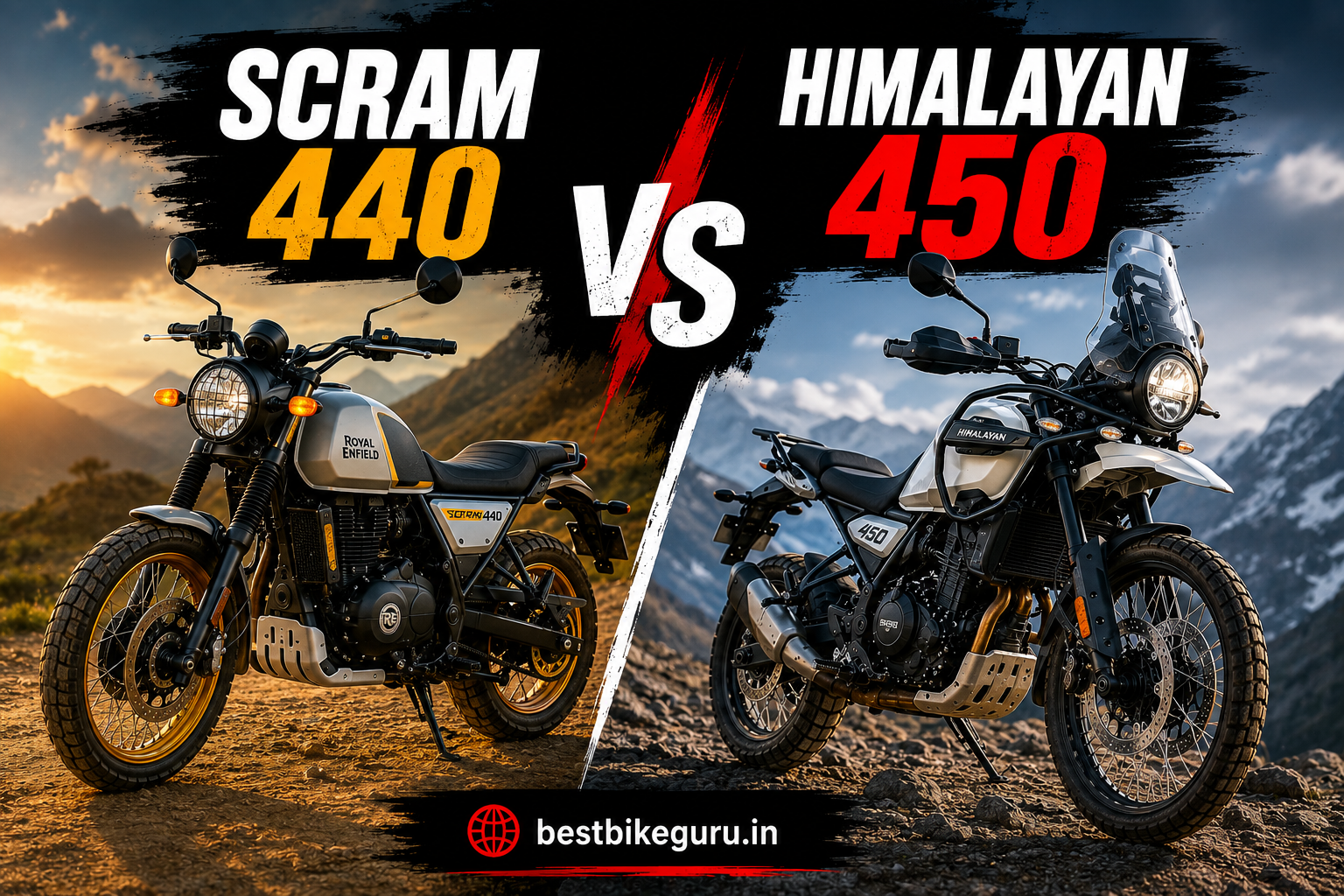
Royal Enfield Scram 440 vs Himalayan 450 : You have made a smart decision already you want a Royal Enfield, you have a decent budget, and you have narrowed it down to two bikes.
The problem is, now you are more confused than ever.
Because the Scram 440 and the Himalayan 450 look similar at first glance. They both come from the same brand. They both have that rugged adventure styling. They both run on engines that are close in character. And yet, the moment you sit on them back to back, or take them out of a city onto a mountain road, they feel like completely different machines built for completely different people.
And that difference is exactly what this article is about.
I am not going to give you a boring spec-sheet comparison that you could copy from any other website. I am going to tell you the truth about what these bikes are like to live with — based on real owner feedback, real-world mileage numbers, and a straight answer to the question: which one is worth your money in 2026?
Quick Answer First — For the Impatient Reader
If you want the one-line verdict before reading everything:
Buy the Scram 440 if you ride mostly in the city, take occasional weekend rides, want lower running costs, and do not plan serious off-road trips.
Buy the Himalayan 450 if you tour regularly, want to do real Ladakh or Spiti trips, need proper adventure capability, and are okay spending about Rs 80,000 more for what is genuinely a much more capable machine.
Now let us break down exactly why.
Price — How Big Is the Gap Really?
Let us start with money because in India, money always matters first.
The Royal Enfield Scram 440 price starts from Rs 2.23 lakh in India. The top variant sits at approximately Rs 2.31 lakh ex-showroom. On-road in a city like Pune or Mumbai, you are looking at around Rs 2.60 to 2.75 lakh all-in.
The Royal Enfield Himalayan 450 starts at Rs 3.06 lakh ex-showroom, with the top Summit and special edition variants going up to Rs 3.37 lakh. On-road in Maharashtra, expect to pay around Rs 3.45 to 3.80 lakh depending on variant and city.
So the gap between the base Scram 440 and the base Himalayan 450 is roughly Rs 83,000 to Rs 90,000.
That is not small. That is your first year’s insurance and service costs combined. Or a solid set of riding gear. The price gap alone will make the decision for many buyers — and that is perfectly valid.
But before you just pick the cheaper one, read the rest. Because that Rs 83,000 buys you some very real differences.
Engine — Same Family, Very Different Character
This is where most comparison articles mislead you. People see “440cc vs 452cc, similar numbers” and assume the engines feel alike. They do not.
The Scram 440 Engine
The Scram 440 uses a 443cc D-platform long-stroke air-cooled single-cylinder engine that produces 25.4 bhp and 34 Nm of torque. Royal Enfield designed this engine specifically for low-end torque and relaxed riding at all road speeds.
What does that mean in practice? It means the Scram 440 is incredibly easy to ride. It pulls smoothly from low RPMs, you do not need to rev it hard to make good progress, and in city traffic or on winding ghat roads, it feels completely natural and unstressed. It is the kind of engine that makes you smile in everyday riding without demanding anything from you.
The downside? At highway speeds above 100 kmph, it starts running out of breath. It will cruise at 90 to 95 kmph comfortably all day. Push it to 110 and it feels like it is working. 120 kmph is possible but not enjoyable.
The Himalayan 450 Engine
The Himalayan 450 is powered by a 451.65cc liquid-cooled engine that produces 40.02 PS at 8000 rpm. This is the Sherpa engine — an entirely different unit from the Scram’s air-cooled motor.
The difference is immediately obvious when you open the throttle. The Himalayan 450 has genuine mid-range punch and keeps pulling strongly all the way to its redline. It can go from 0 to 100 kmph in 6.91 seconds, which is genuinely quick for an adventure bike in this price segment. Highway cruising at 110 to 120 kmph feels effortless, and it still has enough in reserve to safely overtake on national highways.
The trade-off? The engine has noticeable vibrations at higher RPMs, which can be uncomfortable during very long trips. Also, low-end torque is lacking below 3,000 rpm, making it less suited for slow-speed city riding. In heavy traffic, you will find yourself working the clutch and gears more than you would on the Scram.
Winner: Himalayan 450 for performance and highway ability. Scram 440 for city riding ease and relaxed touring.
Mileage — What You Will Actually Get
Both bikes are Royal Enfield, which means real-world mileage will always be lower than claimed. Here is the honest picture.
Scram 440 Real Mileage
The Scram 440 is an air-cooled engine with a focus on relaxed power delivery. In city riding with traffic, expect around 28 to 32 kmpl depending on how hard you ride. On highways at 80 to 90 kmph, you can squeeze out 33 to 36 kmpl. Aggressive riding will drop you into the mid-20s.
Himalayan 450 Real Mileage
The Himalayan 450 provides a decent mileage of 29.54 kmpl in the city and 31.87 kmpl on the highway according to real-world tests. According to user reported data, the Himalayan 450 gives an average mileage of 30 kmpl.
However, owners who push the bike hard on highways or in the mountains report figures closer to 22 to 25 kmpl. The liquid-cooled engine drinks more fuel when pushed.
Running Cost Comparison (Assuming 1500 km per month)
At current petrol prices of around Rs 104 per litre in Maharashtra:
- Scram 440 at 32 kmpl average: approximately Rs 4,875 per month on fuel
- Himalayan 450 at 28 kmpl average: approximately Rs 5,571 per month on fuel
Over a year, that is roughly Rs 8,000 to 10,000 more in fuel for the Himalayan 450. Add the higher purchase price and the ownership cost gap over 3 years is significant.
Winner: Scram 440 on running costs and fuel efficiency.
Off-Road Capability — This Is Where They Diverge Completely
This is the most important section for a large number of buyers and the area where the two bikes are most different.
Scram 440 Off-Road
Most scramblers are based on roadsters with some mechanical and aesthetic changes — they are motorcycles with slight off-road capabilities. The Scram 440 is derived from an adventure motorcycle, retaining the rugged nature of the Himalayan while also suiting urban riding requirements.
The Scram 440 has 190mm of front suspension travel and 180mm at the rear. That is genuinely more than most competitors in the scrambler segment. You can take it on gravel roads, dirt paths, and light trails without feeling out of your depth. It handles broken Indian roads with ease.
But here is the honest truth: the Scram 440 is not built for serious off-roading. Its wheel setup, ground clearance, and tuning are aimed at confident urban and mild off-road use. Take it on a serious rocky mountain trail and it will manage, but you will be working hard against the bike rather than with it.
Himalayan 450 Off-Road
The Himalayan 450 is a genuine adventure machine. From the versatile 21-inch front and 17-inch rear wheel combination to the large enduro footpegs and wide handlebars, the Himalayan works with you in all situations on or off-road.
The high up air intake under the tank keeps you rolling when the rivers are running high — that is a feature designed specifically for real river crossings, not just a marketing line. The adjustable two-piece seat, longer suspension travel, and superior ground clearance make it a capable machine for Ladakh, Spiti, Coorg, and the Western Ghats.
Owner feedback consistently shows that the Himalayan 450 builds enormous confidence off-road in a way the Scram 440 simply does not match.
Winner: Himalayan 450, and it is not close.
Comfort — Which One Will Not Break Your Back
Scram 440 Comfort
The Scram 440 sits you in a slightly upright, relaxed position. The seat height is lower, making it easier to flat-foot at traffic lights. For riders under 5 feet 8 inches, the Scram will feel immediately more manageable.
For daily commuting and rides up to 200 km, the Scram 440 is genuinely comfortable. Beyond that, the lack of wind protection becomes noticeable on highways, and the seat can get firm on very long stretches.
Himalayan 450 Comfort
The Himalayan 450 is built for long distance. It is comfortable for covering long distances in one go and the suspension does the job over roads or no roads without any issues. Multiple owners report doing 500+ km days on it without significant fatigue.
The adjustable two-piece seat keeps both rider and pillion comfortable along with an optional low seat to keep your feet on the ground. This adjustability is a genuine advantage — you can tune the ergonomics to your body rather than adapting to the bike.
The seat height is higher though. Shorter riders, especially those below 5 feet 5 inches, will find the Himalayan 450 slightly intimidating at low speeds and while parking.
Winner: Himalayan 450 for long-distance touring. Scram 440 for shorter daily use.
Features — Technology Comparison
Both bikes have moved well beyond the basic Royal Enfields of even 3 years ago.
Scram 440 Features
The Scram 440 gets a semi-digital instrument cluster, LED headlamp, USB charging port, and dual-channel ABS with rear ABS that can be switched off for off-road riding. The switchable rear ABS is a genuinely useful addition that makes a real difference when you are on loose surfaces.
Himalayan 450 Features
The Himalayan 450 is significantly more loaded. The Himalayan 450 features an LED headlamp, a digital instrument cluster, LED tail lights, connected tech, built-in navigation, and 4 ride modes.
The built-in turn-by-turn navigation is a standout feature. On a touring machine, this is enormously practical — you no longer need a phone mount and navigation app draining your phone battery. The 4 ride modes (Road, Off-road, Long Tour, Rain) genuinely change how the engine and traction control respond, and experienced riders will use them regularly.
Winner: Himalayan 450 on features, comfortably.
Known Issues — What Owners Are Reporting
This is the section that most sponsored bike content will never show you. Here is what actual owners are saying.
Scram 440 Known Issues
Some Scram 440 users have reported instances where the bike fails to start after being turned off during a short halt at traffic signals. Royal Enfield is proactively working to resolve the issue and affected owners will be contacted by respective dealerships to book a service appointment.
This starting issue was reported across multiple units and is worth asking about specifically when you visit the dealership. Make sure your unit has had the update applied before delivery.
Himalayan 450 Known Issues
The Himalayan 450 has two commonly reported issues from long-term owners. First, the engine has noticeable vibrations at higher RPMs which can be uncomfortable during long trips. This is a known characteristic of the Sherpa engine and Royal Enfield has not fully resolved it.
Second, the front-heavy weight distribution makes parking and low-speed manoeuvring in tight spaces genuinely challenging, especially for newer riders. At 196 kg kerb weight, it demands respect in city traffic.
Winner: Neither is perfect. Scram 440’s starting issue is being patched. Himalayan 450’s vibration is a long-term characteristic.
Head-to-Head Comparison Table
| Feature | Scram 440 | Himalayan 450 |
|---|---|---|
| Ex-showroom price | Rs 2.23 – 2.31 lakh | Rs 3.06 – 3.37 lakh |
| Engine | 443cc air-cooled | 452cc liquid-cooled |
| Power | 25.4 bhp | 40 bhp |
| Torque | 34 Nm | 40 Nm |
| Claimed mileage | ~32 kmpl | ~30 kmpl |
| 0-100 kmph | ~9.5 seconds | 6.91 seconds |
| Highway cruising | 90-95 kmph (best) | 110-120 kmph (easy) |
| Off-road ability | Moderate | Excellent |
| Ride modes | No | Yes (4 modes) |
| Navigation | No | Yes (built-in) |
| Seat height | Lower, accessible | Higher, adjustable |
| Ideal for | City + mild touring | Serious touring + off-road |
Also Read : Royal Enfield Himalayan 750 : Price, Specs, Launch Date – India’s Most Anticipated Adventure Tourer
Final Verdict — Which One Should YOU Buy?
After going through everything honestly, here is the simple way to decide:
Choose the Royal Enfield Scram 440 if:
- Your budget is under Rs 2.75 lakh on-road
- You ride mostly in the city with weekend rides
- You are a shorter rider or newer to larger bikes
- You want lower running costs
- Light off-road and ghat roads are your maximum adventure
Choose the Royal Enfield Himalayan 450 if:
- You have done at least one overnight trip and want to do more
- You dream of Ladakh, Spiti, or Coorg on a motorcycle
- Highway comfort matters more than city fuel economy
- You want serious off-road capability and real adventure features
- You ride 2,000+ km a month
Here is our honest overall take: the Himalayan 450 is the better bike. More capable, more features, more refined in the ways that matter for its intended use. But it costs significantly more, both at purchase and in daily running.
The Scram 440 is not the lesser bike — it is a different bike. It does exactly what it promises: brings adventure styling and moderate off-road ability to a price point where more Indian riders can afford it.
Both are worth their money. The question is which one fits your life.
Royal Enfield Scram 440 vs Himalayan 450 FAQ
Is the Scram 440 better than the Himalayan 450 for daily commuting in city?
Yes. The Scram 440’s air-cooled engine, lower seat height, and relaxed power delivery make it significantly more manageable in city traffic than the Himalayan 450. It is lighter on your wrists, easier to park, and more forgiving in slow traffic.
Can the Scram 440 go on a Ladakh or Spiti trip?
It can, but it is not ideal. The Scram 440 will handle the roads, but you will push it harder than the Himalayan 450 and the engine will feel strained on long high-altitude stretches. If Ladakh or Spiti is your plan, the Himalayan 450 is the right tool.
What is the actual mileage of the Himalayan 450 in the city?
Real-world city mileage for the Himalayan 450 is approximately 25 to 30 kmpl depending on riding style. Hard city riding with frequent acceleration will push it toward 22 to 25 kmpl.
Does the Scram 440 have the same engine as the Himalayan 450?
No. The Scram 440 uses a 443cc air-cooled long-stroke engine making 25.4 bhp. The Himalayan 450 uses a completely different 452cc liquid-cooled Sherpa engine making 40 bhp. Same displacement category, very different engines.
Which bike has a better resale value — Scram 440 or Himalayan 450?
The Himalayan nameplate has stronger resale value due to higher demand and wider recognition. Himalayan 450 units in good condition hold their value well. The Scram 440 resale market is still developing given it is a newer model.
Is there a Royal Enfield Scrambler 450 launching in 2026?
Yes, a purpose-built Scrambler 450 on the new 450cc liquid-cooled platform is expected later in 2026. If you can wait until mid to late 2026, it may offer a compelling middle ground between the Scram 440 and the Himalayan 450. We will cover it the moment it launches.